Showing posts with label Kate Chopin. Show all posts

Sunday, February 2, 2025

A Respectable Woman

Kate Chopin (1850–1904)
From Kate Chopin: Complete Novels & Stories

“Planter’s House on the Mississippi,” c. 1870–72, unidentified plantation in Louisiana. Illustration by Alfred R. Waud (1828–1891), engraved by John Hellawell (1837–1919) for inclusion in Picturesque America; or, The Land We Live In, volume 1, 1872, edited by William Cullen Bryant.
Kate Chopin rarely included literary quotations or allusions in her stories. Perhaps the best-known example, however, appears in “A Respectable Woman.” At a pivotal point in the story, Gouvernail, a bachelor visiting the Baroda family’s plantation, murmurs “half to himself” two lines from section 21 of Walt Whitman’s Song of Myself:
Night of south winds—night of the large few stars!
Still nodding night——
A college friend of Gaston Baroda, Gourvernail is spending time at the plantation, much to the initial disappointment of Mrs. Baroda, who had been looking forward to a few weeks of rest and time alone with her husband. A few days into the visit, she has changed her mind about her guest, who utters the above verse from Whitman as the two of them are sitting outside in the evening. What neither Chopin nor Gouvernail includes, quite deliberately, is the opening line and last phrase of the stanza:
Press close bare-bosom’d night—press close magnetic nourishing night!
Night of south winds—night of the large few stars!
Still nodding night—mad naked summer night.
And the section ends:
Prodigal, you have given me love—therefore I to you give love!
O unspeakable passionate love.
The allusion to Song of Myself allowed Chopin to suggest what she could not explicitly describe in a nineteenth-century publication—even in a magazine as transgressive for the era as Vogue. She expected (or hoped) many of her readers would recognize the lines and understand the full significance of the tension passing at that moment between Mrs. Baroda and Gouvernail.

A journalist from New Orleans, Gouvernail is one of Chopin’s most interesting recurring characters. He reappears in a later story, “Athénaïse,” in which he has a brief dalliance with a married woman who, unlike Mrs. Baroda, is unhappy with her husband. Both stories were published in Chopin’s collection A Night in Arcadie, and in an introduction to a recent edition, Bernard Koloski underscores how, in each of the two tales, “Gouvernail approaches the intimate circle of a married woman [and] understands the woman in some ways better than she does herself. Kate Chopin does not often assign such understanding to a man.”

Gouvernail appears one last time at the dinner party near the end of Chopin’s best-known work, The Awakening. He observes the guests and once again mutters lines from a poem—the only words he speaks in the novel. This time, the quote is from Algernon Charles Swinburne’s “A Cameo,” a poem about the relief that death brings from the pain brought on by life’s emotional extremes—thus foreshadowing the novel’s climax. As Joyce Dyer puts it in an essay focusing on the “gracious and courteous” Gouvernail, he progresses from “sensual bachelor to disappointed lover to love cynic” before vanishing from Chopin’s fiction entirely.

*   *   *
For this week’s selection, we depart from the usual format and reproduce the entire text of Chopin’s short story below. You may also download it as a PDF or view it in Google Docs, and this selection may be photocopied and distributed for classroom or educational use.

A Respectable Woman

Mrs. Baroda was a little provoked to learn that her husband expected his friend, Gouvernail, up to spend a week or two on the plantation.

They had entertained a good deal during the winter; much of the time had also been passed in New Orleans in various forms of mild dissipation. She was looking forward to a period of unbroken rest, now, and undisturbed tête-a-tête with her husband, when he informed her that Gouvernail was coming up to stay a week or two.

This was a man she had heard much of but never seen. He had been her husband’s college friend; was now a journalist, and in no sense a society man or “a man about town,” which were, perhaps, some of the reasons she had never met him. But she had unconsciously formed an image of him in her mind. She pictured him tall, slim, cynical; with eye-glasses, and his hands in his pockets; and she did not like him. Gouvernail was slim enough, but he wasn’t very tall nor very cynical; neither did he wear eye-glasses nor carry his hands in his pockets. And she rather liked him when he first presented himself. But why she liked him she could not explain satisfactorily to herself when she partly attempted to do so. She could discover in him none of those brilliant and promising traits which Gaston, her husband, had often assured her that he possessed. On the contrary, he sat rather mute and receptive before her chatty eagerness to make him feel at home and in face of Gaston’s frank and wordy hospitality. His manner was as courteous toward her as the most exacting woman could require; but he made no direct appeal to her approval or even esteem.

Once settled at the plantation he seemed to like to sit upon the wide portico in the shade of one of the big Corinthian pillars, smoking his cigar lazily and listening attentively to Gaston’s experience as a sugar planter.

“This is what I call living,” he would utter with deep satisfaction, as the air that swept across the sugar field caressed him with its warm and scented velvety touch. It pleased him also to get on familiar terms with the big dogs that came about him, rubbing themselves sociably against his legs. He did not care to fish, and displayed no eagerness to go out and kill grosbecs when Gaston proposed doing so.

Gouvernail’s personality puzzled Mrs. Baroda, but she liked him. Indeed, he was a lovable, inoffensive fellow. After a few days, when she could understand him no better than at first, she gave over being puzzled and remained piqued. In this mood she left her husband and her guest, for the most part, alone together. Then finding that Gouvernail took no manner of exception to her action, she imposed her society upon him, accompanying him in his idle strolls to the mill and walks along the batture. She persistently sought to penetrate the reserve in which he had unconsciously enveloped himself.

“When is he going—your friend?” she one day asked her husband. “For my part, he tires me frightfully.”

“Not for a week yet, dear. I can’t understand; he gives you no trouble.”

“No. I should like him better if he did; if he were more like others, and I had to plan somewhat for his comfort and enjoyment.”

Gaston took his wife’s pretty face between his hands and looked tenderly and laughingly into her troubled eyes. They were making a bit of toilet sociably together in Mrs. Baroda’s dressing-room.

“You are full of surprises, ma belle,” he said to her. “Even I can never count upon how you are going to act under given conditions.” He kissed her and turned to fasten his cravat before the mirror.

“Here you are,” he went on, “taking poor Gouvernail seriously and making a commotion over him, the last thing he would desire or expect.”

“Commotion!” she hotly resented. “Nonsense! How can you say such a thing? Commotion, indeed! But, you know, you said he was clever.”

“So he is. But the poor fellow is run down by overwork now. That’s why I asked him here to take a rest.”

“You used to say he was a man of ideas,” she retorted, unconciliated. “I expected him to be interesting, at least. I’m going to the city in the morning to have my spring gowns fitted. Let me know when Mr. Gouvernail is gone; I shall be at my Aunt Octavie’s.”

That night she went and sat alone upon a bench that stood beneath a live oak tree at the edge of the gravel walk.

She had never known her thoughts or her intentions to be so confused. She could gather nothing from them but the feeling of a distinct necessity to quit her home in the morning.

Mrs. Baroda heard footsteps crunching the gravel; but could discern in the darkness only the approaching red point of a lighted cigar. She knew it was Gouvernail, for her husband did not smoke. She hoped to remain unnoticed, but her white gown revealed her to him. He threw away his cigar and seated himself upon the bench beside her; without a suspicion that she might object to his presence.

“Your husband told me to bring this to you, Mrs. Baroda,” he said, handing her a filmy, white scarf with which she sometimes enveloped her head and shoulders. She accepted the scarf from him with a murmur of thanks, and let it lie in her lap.

He made some commonplace observation upon the baneful effect of the night air at that season. Then as his gaze reached out into the darkness, he murmured, half to himself:

      “‘Night of south winds—night of the large few stars!
      Still nodding night——’”

She made no reply to this apostrophe to the night, which indeed, was not addressed to her.

Gouvernail was in no sense a diffident man, for he was not a self-conscious one. His periods of reserve were not constitutional, but the result of moods. Sitting there beside Mrs. Baroda, his silence melted for the time.

He talked freely and intimately in a low, hesitating drawl that was not unpleasant to hear. He talked of the old college days when he and Gaston had been a good deal to each other; of the days of keen and blind ambitions and large intentions. Now there was left with him, at least, a philosophic acquiescence to the existing order—only a desire to be permitted to exist, with now and then a little whiff of genuine life, such as he was breathing now.

Her mind only vaguely grasped what he was saying. Her physical being was for the moment predominant. She was not thinking of his words, only drinking in the tones of his voice. She wanted to reach out her hand in the darkness and touch him with the sensitive tips of her fingers upon the face or the lips. She wanted to draw close to him and whisper against his cheek—she did not care what—as she might have done if she had not been a respectable woman.

The stronger the impulse grew to bring herself near him, the further, in fact, did she draw away from him. As soon as she could do so without an appearance of too great rudeness, she rose and left him there alone.

Before she reached the house, Gouvernail had lighted a fresh cigar and ended his apostrophe to the night.

Mrs. Baroda was greatly tempted that night to tell her husband—who was also her friend—of this folly that had seized her. But she did not yield to the temptation. Beside being a respectable woman she was a very sensible one; and she knew there are some battles in life which a human being must fight alone.

When Gaston arose in the morning, his wife had already departed. She had taken an early morning train to the city. She did not return till Gouvernail was gone from under her roof.

There was some talk of having him back during the summer that followed. That is, Gaston greatly desired it; but this desire yielded to his wife’s strenuous opposition.

However, before the year ended, she proposed, wholly from herself, to have Gouvernail visit them again. Her husband was surprised and delighted with the suggestion coming from her. “I am glad, chère amie, to know that you have finally overcome your dislike for him; truly he did not deserve it.”

“Oh,” she told him, laughingly, after pressing a long, tender kiss upon his lips, “I have overcome everything! you will see. This time I shall be very nice to him.”

Originally published in the February 15, 1894, issue of Vogue and collected in A Night in Acadie (1897).

Sunday, February 4, 2024

A Point at Issue!

Kate Chopin (1850–1904)
From Kate Chopin: Complete Novels & Stories

Les Grands Boulevard (Café Américain), c. 1884–95, oil on canvas by French artist Jean Béraud (1849–1935). Image: Sotheby’s.
     From Chopin’s story: “He took refuge at one of the small tables of a café, called for a ‘Mazarin,’ and, so seated for an unheeded time, let the panorama of Paris pass before his indifferent eyes.”
In May 1889, Kate Chopin finished the first short story she considered good enough to send out for publication. All we know about the tale, which was titled “A Poor Girl,” is the following entry in her manuscript book that records the trajectory of each one of her works:
Returned from Home Mag . Dec. 1 — objection to incident not desirable to be handled
remarks “well written , full of interest” if changed, would consider
Gave to John Dillon to read Dec. 11
Sent to New York Ledger May 1890.
Returned from New York Ledger June 5
destroyed
We don’t know the nature of the “incident” the editors at Home (probably Arthur’s Home Magazine, a popular monthly journal for women) found objectionable, although the criticism that something in a story was “not desirable to be handled” was one Chopin would receive frequently during her career. After the first rejection, she showed the story to John Dillon, the editor of the St. Louis Post-Dispatch, before sending it out again for another dismissal. She often sought his advice and feedback during the next few years, and the newspaper generally championed Chopin and her writing in the years ahead.

During the remainder of 1889, Chopin wrote four other pieces and had much better luck placing them. In June she finished “Wiser Than a God.” A story about a concert pianist, it was accepted by the Philadelphia Musical Journal, the first publication she sent it to, and it appeared in the December number. In August she wrote “A Point at Issue!” and it seems she likely shared it with Dillon for comment because in late October the Post-Dispatch published it with the subtitle “A Story of Love and Reason in Which Love Triumphs”—her first story to appear in print. She received $15 for it—three times the amount the Musical Journal paid her. Two stories she completed toward the end of the year underwent a rockier reception; between them they accumulated nine rejections before finding homes. Throughout the year, she also worked steadily on her first novel, At Fault, which she published in 1890.

During the next decade, Chopin wrote nearly one hundred stories and two more novels, including her controversial masterpiece The Awakening. (She couldn’t find a publisher for her second novel, “Young Dr. Gosse,” and after numerous rejections, she destroyed the manuscript.) When she began her writing career, she was a 39-year-old widow busy raising a 9-year-old daughter and five sons ranging in age from 11 to 18. In 1907, three years after Chopin’s death, her daughter, Lelia, recalled how her mother managed to get any writing done:
She always wrote best in the morning, “when the house was quiet,” as she said. She always wrote rapidly with a lead pencil on block paper. When finished, she copied her manuscript in ink, seldom changing a word, never “working over” a story or changing it materially. She did not have a study or any place where she ever really shut herself off from the household. I know now that she often desired to do this when writing, but on the other hand, she never wished to shut us children out of her presence, and with the natural selfishness of children, we never tried to keep her undisturbed as she should have been.
Lelia might have romanticized her childhood recollections; the household’s circumstances certainly changed over the course of the following decade. As Chopin’s sons grew older and moved out, the space and time available for her writing improved. An article published in November 1899 in the Post-Dispatch, titled “A St. Louis Woman Who Has Won Fame in Literature,” shows her spacious study in a watercolor by Chopin’s son Oscar, an art student at the time and a future cartoonist. Chopin biographer Emily Toth describes the sketch as depicting “a well-appointed room, with well-stocked bookshelves on either side of the fireplace, an intricate musical clock on the mantel, framed pictures on the walls above a nude Venus and interesting bric-a-brac on the shelves. In the armchair, leaning back and looking almost ghostly, is Kate Chopin (who liked to write in her favorite chair, beside the grate fire).”

Both of Chopin’s first two published stories were about the struggle between marital obligations and, as she put it, “a woman’s intellectual existence.” The pianist in “Wiser Than a God” is confronted with a choice: accepting a marriage proposal or continuing her career. “A Point at Issue!” tackles the same dilemma from a different, satirical angle: Charles Faraday, a professor of mathematics, marries Eleanor Gail, who wishes to continue her education and maintain a modicum of independence: “Marriage was to be a form, that while fixing legally their relation to each other, was in no wise to touch the individuality of either.” Oblivious and uncaring of what their social circle thinks of the arrangement, the couple agrees that Eleanor should spend the academic year living alone in Paris so that she can learn how to speak French more fluently. The separation, built on the “trust in each other’s love,” does not go as smoothly as either of them hoped.

Note: A Mazarin is a cake with almond paste filling.

*   *   *
Married—On Tuesday, May 11, Eleanor Gail to Charles Faraday.

Nothing bearing the shape of a wedding announcement could have been less obtrusive than the foregoing. . . . If you don't see the full selection below, click here (PDF) or click here (Google Docs) to read it—free!

This selection may be photocopied and distributed for classroom or educational use.

Sunday, February 5, 2023

A Visit to Avoyelles

Kate Chopin (1850–1904)
From Kate Chopin: Complete Novels & Stories

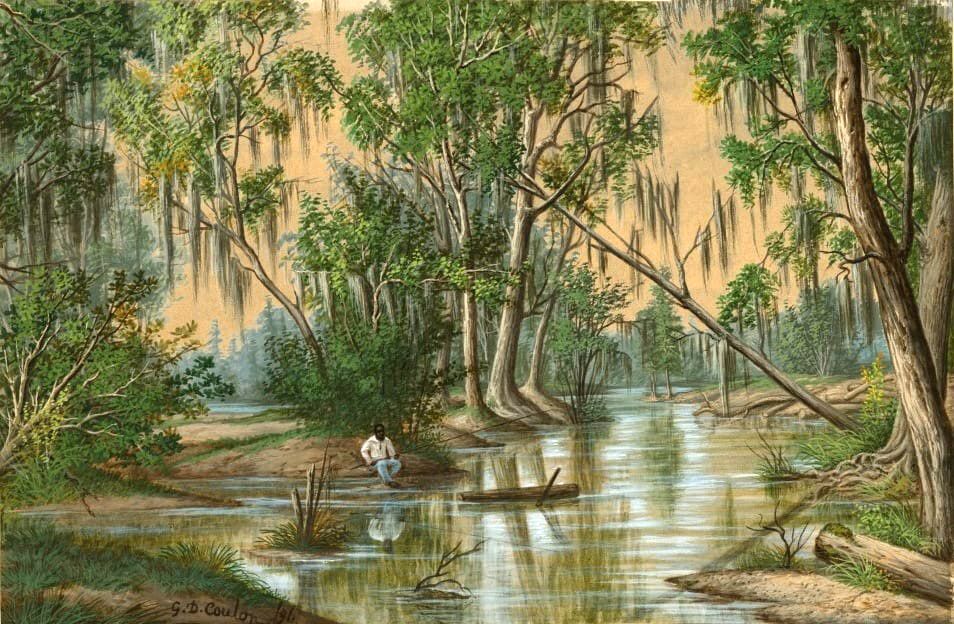
Bayou des Cotes, Parish of Avoyelles, Louisiana, 1891, watercolor on paper mounted on board by Louisiana artist George David Coulon (1822–1904). The Historic New Orleans Collection.
Thirteen years ago, soon after the launch of the Story of the Week site, we presented to readers “Désirée’s Baby,” a story that was Kate Chopin’s most—or, some might argue, only—well-known work after her death and until her “rediscovery” in the 1970s. The story continues to be widely taught in schools and colleges and remains one of our most popular offerings—always in the top 25 of the more than 600 selections to date.

In a way, though, that’s only half the story. When Chopin’s famous tale appeared in 1893, in the fifth issue of the new magazine Vogue, it was the first episode of a two-part selection retitled by the editors as “Character Studies: The Father of Désirée’s Baby—The Lover of Mentine.”

Chopin separated the two works when she included them in her 1894 collection, Bayou Folk, and she restored the original title, “A Visit to Avoyelles,” to the story about Mentine. Both tales are set in Louisiana and portray women with disagreeable husbands—but there the similarity ends. While “Désirée’s Baby” is (to quote Cynthia Griffin Woolf) “an economical, tight psychological drama” with a surprise ending, “A Visit to Avoyelles” resembles the “local-color” sketches that had brought Chopin to the attention of the reading public over the previous three years. “If the two stories are read immediately one after the other,” remarks the Spanish literary scholar Teresa Gibert, “the contrast between them is striking, since Chopin’s quaint depiction of Cajun manners in ‘A Visit to Avoyelles’ is not paralleled by a symmetrically optimistic representation of Creole mores in ‘Désirée’s Baby.’” Even so, in just 1,300 words, “A Visit to Avoyelles” transcends many local-color tales in its portrayals of both the protagonist—a man who impetuously travels more than 80 miles across the state of Louisiana on a rescue mission—and the object of his romantic fantasy: a woman who doesn’t think she needs rescuing.

During the rest of the 1890s, seventeen additional stories by Chopin appeared in Vogue—including several that no other publication would touch. Founded by Arthur Turnure, a wealthy heir who had been an art director at Harper & Brothers, and backed with funds from the likes of Cornelius Vanderbilt and Marion Fish, the weekly gazette at first was read as much for its high-society news as for its fashion coverage. For the first eight years, Vogue’s editor-in-chief was the journalist Josephine Redding, an unconventional socialite known for her trove of oversize hats, her refusal to wear corsets, and a dedication to animal welfare causes. Redding’s notable contributions to Vogue include the magazine’s title and the introduction of dress patterns, with coupons that could be mailed in with fifty cents to receive the full-size versions.

At the end of 1894, to celebrate the success of Vogue’s first two years, Redding assembled a full-page collection of portraits entitled “Those Who Have Worked with Us,” placed an illustration of Chopin top and center, and wrote in the accompanying article, “Mrs. Chopin is daring in her choice of themes, but exquisitely refined in the treatment of them, and her literary style is a model of terse and finished diction.” Chopin’s recent biographer Emily Toth remarks, “While few well-known American writers appeared in Vogue (and no other local colorists), Kate Chopin found in its pages her own showcase, and she used it to experiment with a more radical realism and a less traditional—and less happy—view of the world.”

Glossary:
Comment! – How is this!
Non, j’te garantis! – No, I guarantee you.
’tit [petit] sauvage, va! – Little savage, go on!
Other French phrases are simple exclamations or will be apparent from context.

*   *   *
Every one who came up from Avoyelles had the same story to tell of Mentine. . . . If you don't see the full selection below, click here (PDF) or click here (Google Docs) to read it—free!

This selection may be photocopied and distributed for classroom or educational use.

Sunday, August 28, 2022

Wiser Than a God

Kate Chopin (1850–1904)
From Kate Chopin: Complete Novels & Stories

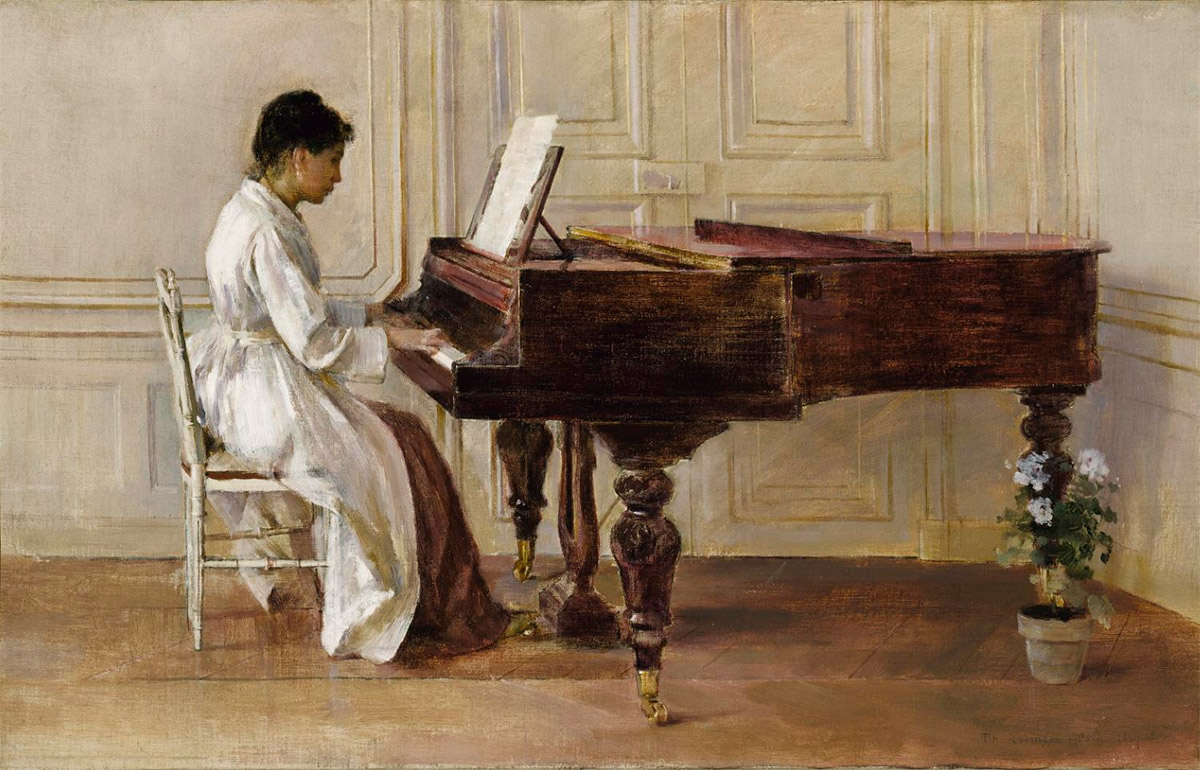
At the Piano, 1887, oil on canvas by American artist Theodore Robinson (1852–1896). Courtesy Smithsonian American Art Museum.
In 1884, two years after her husband’s death from malaria, Kate Chopin moved back to her native St. Louis. She was thirty-four years old and a mother of six children ranging in age from 4 to 13. After a short-lived attempt to live in the home of her mother and her mother’s sister, also widows, she and the children moved into a house across the street. Chopin had lived in Louisiana with her husband for fourteen years, first in New Orleans, and then two hundred miles to the northwest in the rural town of Cloutierville, where she became somewhat notorious for her horseback riding, card playing, Cuban cigarettes, extravagant dresses purchased in the city, and—after her husband died—a romance with a married man.

Chopin had been living in St. Louis for barely more than a year when her mother died of cancer at the age of 54. “I think the tragic death of her father early in her life, of her much-loved brothers, the loss of her young husband and her mother, left a stamp of sadness on her which was never lost,” Kate’s youngest child (and only daughter), Lelia, wrote two decades later. Chopin moved her family four miles across town after her mother’s death, in part, according to biographer Emily Toth, to get away from the supervision of her aunt, “who would surely notice that Kate had stopped going to mass.”

In her new neighborhood, Chopin reconnected with friends from her childhood years, as well as an expanded circle of freethinkers, artists, and journalists, including Joseph Pulitzer, whose newspaper would publish some of her stories. “She was not interested in the woman's suffrage movement,” her youngest son, Felix, recalled in 1949. “But she belonged to a liberal, almost pink-red group of intellectuals, people who believed in intellectual freedom and often expressed their independence by wearing eccentric clothing.”

The physician Frederick Kolbenheyer, who had befriended Chopin a decade earlier, was one member of her new social circle. The previous decade, he had been the attending obstetrician for two of Kate’s children, each born in St. Louis when she had returned to spend time with her mother. A scion of an aristocratic family in Austria, Kolbenheyer had rebelled against his father and had come to the United States because of his outspoken opposition to the Hapsburg monarchy—or, more precisely, because he had been strongly advised to leave his native country. He served as physician to many of the leading families of St. Louis, but his primary practice was among the poorer inhabitants in the city’s South Side. Chopin and Kolbenheyer corresponded frequently during her years in Louisiana, and the letters she wrote impressed the doctor so much that, after she moved back to St. Louis, he urged her to become a writer.

Chopin began by attempting a novella-length story, “Euphrasie,” which she would eventually condense from 30,000 to 10,000 words and retitle “A No-Account Creole.” That initial effort would not be finished for several years; instead her first publication, which appeared in 1888, was the sheet music for an original composition, “Lilia, Polka for Piano.” In January 1889, she placed a poem, “If It Might Be,” in America, a progressive Chicago-based journal. And, finally, in June of that year, she finished the first of nearly eighty stories accepted for publication during the next thirteen years.

A romantic comedy that defies the formula, “Wiser Than a God” is, in part, Kate Chopin’s evocation of her grief over her mother’s death—and probably her response to the gentleman callers who might have assumed she was eager to get married again. In addition, it was almost certainly inspired by the career of German opera singer Antoinette Fehringer, whom Kate had met when she was nineteen years old. In 1866 Fehringer arrived in New Orleans from the Victoria Theater in Berlin and guest-starred in several productions during the first two seasons of the just-built National Theatre. She also proved to be a talented concert pianist and claimed to have been taught by the composer Franz Liszt. In July 1868, she retired from her professional stage career and married Adolph Bader, one of the city’s wealthier residents—a match (according to the Daily Democrat) “made romantic by a duel with a supposed rival.” The following spring Kate, with her mother, a younger cousin, and three other women, went on a pleasure trip to New Orleans, where she met the Baders. She later wrote in her diary:
One evening I passed in New Orleans which I shall never forget—it was so delightful and novel. Mamie and I were invited to dine and spend the evening with a Mrs. Bader, a German lady. . . . I quaffed all sorts of ales and ices—talked French and German—listened enchanted to Mrs. Bader’s exquisite singing and for two or three hours was as gay and happy as I ever had been in my life. Mrs. Bader had been but a year married, she was the famous Miss Ferringer—Singer and Schauspielerin [actress], who in order to support indigent parents went upon the stage, thereby not only retaining respect, but gaining it from every quarter. Her talents and womanly attractions won her a kind and loving husband—Mr. Bader—one of the first merchants of New Orleans, a man worth $600,000.
“Wiser Than a God” was published in the Philadelphia Musical Journal in December 1889, twenty years after her meeting with Antoinette Fehringer. Like many of Chopin’s stories, it deals with the tensions between family and independence and between marriage and career. “Kate Chopin was not an activist,” concludes Emily Toth, “but her earliest stories were about women who created their own destinies.”

Notes: In 1737, Italian opera singer Carlo Farinelli (misspelled by Chopin as Faranelli) retired from his public career and became the official singer of the court of King Philip V of Spain, a post he held for 25 years. To relieve Philip’s depression, Farinelli would sing the same four songs every night. Chopin includes two snippets of dialogue in German: “Ist es nicht wonderschen?” (Isn’t it wonderful?) and “Ach Gott! Fräulein Von Stoltz ist schon im Leipsic gegangen!” (Oh God! Fraulein Von Stoltz has already gone to Leipzig!)

*   *   *
“You might at least show some distaste for the task, Paula,” said Mrs. Von Stoltz, in her querulous invalid voice, to her daughter who stood before the glass bestowing a few final touches of embellishment upon an otherwise plain toilet. . . . If you don't see the full selection below, click here (PDF) or click here (Google Docs) to read it—free!

This selection may be photocopied and distributed for classroom or educational use.

Sunday, October 10, 2021

Miss McEnders

Kate Chopin (1850–1904)
From Kate Chopin: Complete Novels & Stories

Employees heading home at the end of the day from Brown’s Shoe Factory, Washington & 18th Streets, St. Louis, Missouri, 1910. Photograph by Lewis Wickes Hine. Library of Congress. “Georgie had just discovered that she had yet an hour to spare before starting out with the committee of four to further investigate the moral condition of the factory-girl.” —from “Miss McEnders”
In the annals of St. Louis during the period after the Civil War, few men played a larger role in sketchy political shenanigans than did William McKee, one of three joint owners of the Missouri Democrat newspaper. Founded in 1852, the Democrat was fully aligned with the Republican Party by the end of the decade, while in a bizarre historical quirk the Missouri Republican supported the Democrats. From the beginning, McKee’s paper positioned itself with an antislavery stance—or, at least, it professed as much support for an eventual, “peaceable emancipation” as the reading public in a slave state would tolerate—and it became an early ally in Abraham Lincoln’s presidential campaign.

Lincoln’s victory in the 1860 election, followed by the Union’s victory in the Civil War, ensured McKee’s prominence in the party. One measure of his influence was his ability to handpick the census takers in St. Louis. As cities began to report their counts in 1870, McKee convinced his officials to wait until Chicago announced its figures. After Chicago logged a population just shy of 300,000, St. Louis boasted a total of 310,864—almost twice the count ten years earlier—which made St. Louis the nation’s fourth largest city, behind New York, Philadelphia, and Brooklyn. Although the numbers were greeted with incredulity by Chicago officials and even by the Fourth City’s own residents, the fraud wasn’t exposed until ten years later, when Joseph Pulitzer, publisher of the rival St. Louis Post-Dispatch, reported that census officials had included names of people who didn’t live in St. Louis.

McKee’s census hoax was relatively benign compared to his involvement in the Whisky Ring, the scandal that nearly brought down the presidential administration of Ulysses S. Grant. In the early 1870s, to avoid the hefty tax on whisky sales, distillers paid government officials half the amount for the duty stamps affixed to bottles. The money was then siphoned off the books, initially to advance Republican Party interests. The conspiracy, which reached all the way to the Cabinet, quickly outgrew “its humble slush fund origins to become by 1873 a purely criminal enterprise, defrauding the federal treasury of an estimated million and a half dollars a year,” writes Timothy Rives of the National Archives. The scheme originated in St. Louis and one of the ringleaders was McKee, who skimmed as much as $300,000 for himself—money pumped directly into his newspaper business to create the St. Louis Globe. McKee eventually merged both papers as the Globe-Democrat, which boasted one of the largest circulations west of the Mississippi. When the conspiracy was uncovered by a new Secretary of the Treasury, more than 300 people were arrested and 110 were convicted. McKee received a two-year sentence and a $10,000 fine, but he was pardoned by Grant after staying in the city jail for only six months—during which he spent nights at home with his family.

When McKee died in 1879, his estate and the controlling interest in the Globe-Democrat passed first to his wife, Eliza, and then in 1892 to his daughter, Ellen, both of whom quietly used their fortune to fund women’s societies, educational organizations, morality campaigns, and Christian missions abroad. Kate Chopin, who had returned to St. Louis from New Orleans in 1884, two years after the death of her husband, got to know Ellen McKee—and she apparently was not entirely fond of the conservative, high-minded heiress.

McKee and Chopin probably became well acquainted in the months after December 1890, when Chopin became a charter member of the Wednesday Club, an organization whose stated purpose was “to create and maintain an organized center of thought and action among the women of St. Louis, and to aid in the promotion of their mutual interests, in the advancement of science, education, philanthropy, literature and art.” Founded by Charlotte Eliot (whose youngest child, the future poet T. S. Eliot, was still an infant), the club at first seemed appealing to Chopin—she even delivered to its members a lecture on German composers—but within eighteen months she resigned, apparently dissatisfied with the requirement that members belong to one of the “study clubs” (Current Topics, Social Economics, etc.) and with the artsy pretensions and sanctimonious righteousness of some of the women. She described one particularly irritating member in her diary: “The spirit of the reformer burns within her, and gives to her eyes the smouldering, steady glow of a Savonarolas [sic]. The condition of the working classes wrings her heart. ‘Work’ is her watch word.”

In March 1892, the month before she left the organization, Chopin wrote the story “Miss McEnders,” about a social reformer concerned about the “moral condition” of St. Louis’s many female workers, and there is no doubt that the eponymous character was modeled after Ellen McKee or that the organization in the story was a caricature of the Wednesday Club. Although Chopin was approaching the peak of her career, when most of her writings found publishers, no editor would touch the story. (Eliza McKee's death that April, which was widely reported, may well have reinforced the hesitation of editors who recognized the target of the satire.) The tale finally appeared five years later in the March 6, 1897, issue of The Criterion, a new St. Louis literary magazine that had risen from the ashes of St. Louis Life after its purchase by Grace L. Davidson, a former schoolteacher. Davidson did not have the kind of wealth necessary to maintain such an enterprise, and so the publication was entirely dependent on the $1,000 a week donated by none other than Ellen McKee.

In case local readers missed the connection, Post-Dispatch journalist William Marion Reedy was more than happy to point it out. “Miss McKee is devoted to charities of all kinds, including the maintenance of fashionable weeklies,” he wrote. “The publication of the tale is a splendid example of biting the hand that feeds.” Reedy, who knew full well (but did not reveal) who wrote the story, also related that McKee herself didn’t “believe the ‘explanation’ that the story was not intended to mock her philanthropic tastes and revile her father’s memory.” The authorship of the piece was something of an open secret among the St. Louis upper crust, so the odds are that McKee found out soon enough who had written it.

Six months later, McKee paid to have The Criterion’s offices moved to New York and in January 1898, after yet another infraction against decency, its editor, Henry Dumay, was fired. The following year McKee’s paper, the Globe-Democrat, which had never been kind to Chopin or her books, led the charge against her second novel The Awakening: “It is not a healthy book; if it points to any particular moral or teaches any lesson, the fact is not apparent.” It is unknown whether McKee and Chopin encountered ever each other again.

Note: American economist Henry George crisscrossed the country during the 1890s, delivering speeches maintaining that a single tax on land would cover the costs of government. The French expression c’est un propre, celui la! translates as “That’s a proper one, that one there!”

Many of the above details and quotes concerning both the Wednesday Club and William Marion Reedy are culled from Emily Toth’s biographies Kate Chopin and Unveiling Kate Chopin.

*   *   *
When Miss Georgie McEnders had finished an elaborately simple toilet of gray and black, she divested herself completely of rings, bangles, brooches—everything to suggest that she stood in friendly relations with fortun. . . . If you don't see the full selection below, click here (PDF) or click here (Google Docs) to read it—free!

This selection may be photocopied and distributed for classroom or educational use.

Sunday, February 7, 2021

A Shameful Affair

Kate Chopin (1850–1904)
From Kate Chopin: Complete Novels & Stories

The New Novel, 1877, watercolor on paper by American artist Winslow Homer (1836–1910). Wikimedia Commons.
Kate Chopin’s husband died of yellow fever in New Orleans in 1882, leaving her with $12,000 worth of debts and six children ranging in age from three to eleven (the five oldest were boys). After paying off the creditors in full and struggling to make ends meet for two years, she left New Orleans and returned to St. Louis to live with her mother, who had moved across the street from Chopin’s childhood home. After her mother unexpectedly died the following year, Chopin and her children survived more or less comfortably off the rental income from the properties she inherited.

By the end of the decade, to supplement her income, Chopin had begun writing short stories for regional publications and in 1890 she self-published her first novel, At Fault, to largely favorable notices from local reviewers. The following year, unable to find a publisher for her second novel, she destroyed the manuscript and turned her full attention to stories, writing more than forty of them in the next three years. All but two of the sixteen she published during 1891 were eventually published—although many faced numerous rejections before finally finding a home. She had begun pushing the limits of what was considered acceptable for women to write about in fiction. The first story she finished in 1891, “Mrs. Mobry’s Reason,” portrayed a woman with congenital syphilis and received more rejection notices than anything she ever wrote—fourteen in all—before the New Orleans Times-Democrat published it in April 1893. What made the story suddenly marketable was the transatlantic notoriety of the just-published novel Her Heavenly Twins, by British suffragist Sarah Grand, which depicted the devastating disease that philandering husbands inflicted on their wives and children. Chopin made minor changes to her story that would instantly evoke Grand’s book in the minds of Times-Democrat readers.

During this period, Chopin also began writing more of the “local color” stories set in Louisiana that would make her famous, but many of the early stories (including “Mrs. Mosby’s Reason”) took place in or near St. Louis. In the summer of 1891, she took her family 25 miles south to Sulphur Springs, where she probably wrote “A Shameful Affair.” Biographer Emily Toth suggests that Chopin may have named the story’s farmhand after her youngest son, Fred, as a “teasing wink.” By all accounts, Fred Chopin was a popular, rowdy, and mischievous youth whose adulthood, after a period of aimless job-hopping, proved relatively unremarkable. The highlight of his adult life seems to have been the year he spent training as a soldier during the Spanish-American War, although the fighting ended soon after his battery arrived in Puerto Rico, before any of them had fired a shot. In 1914 his divorce and a secret second marriage would make local news as a scandal du jour, and he ended up in California as a failed concert pianist whose day job was working for an Oakland candy manufacturer.

Chopin, of course, had no way of anticipating the direction of her fifteen-year-old son’s future when she wrote “A Shameful Affair.” Still, it seems likely that the story could have been as much a warning as a wink—although if Fred were anything like his fictional counterpart, he may have never read it. As a mother, Chopin had six case studies of adolescent “awakenings” in her household. As an author, she “was interested in the passion and drives of man (her ‘brutes’) as well as of woman (her ‘beauties’),” as Joyce C. Dyer notes in an essay on Chopin’s stories, which feature “complex creatures who have no choice but to discover their passion, in spite of risks, confusion, and guilt.” One of several precursors to her famous novel The Awakening, “A Shameful Affair” portrays the fumbling sexual advances of Fred and Mildred, two young adults invigorated by a rural environment that would serve a similar literary purpose in the next century for such writers as D. H. Lawrence and Sherwood Anderson (see especially “The New Englander”). In a later essay focusing on this story, Dyer acknowledges that “the landscape of ‘A Shameful Affair’ is neither as exotic nor as symbolically complex as the landscape in The Awakening,” yet without the descriptions of the farm the story would be “not as subtle and artistically satisfying.”

While certainly not as scandalous as a story on venereal disease, the post-adolescent passions of “A Shameful Affair” must have still been too much for fiction editors. Chopin’s account book indicates she wrote it in June 1891 and received rejections during the next year from St. Louis’s new literary journal The Chaperone, the short-lived Belford’s Magazine, Cosmopolitan, Scribner’s, The Argonaut, Ladies Home Journal, Frank Leslie's Illustrated Newspaper, Vogue (which only a few years later would be more than happy to publish stories by Chopin that no other publisher would touch), and Godey's Magazine. The story ended up at the Times-Democrat, the same newspaper that would later accept “Mrs. Mosby’s Reason.” Chopin was paid five dollars.

Despite a pivotal scene that may have made the nation’s starchy editors squirm, Toth claims that “A Shameful Affair” otherwise displays “William Dean Howells's genteel approach to romantic comedy,” a stance Chopin would soon abandon as she read more of the new novels and stories arriving from Europe. The story ends on a humorous note that, while ambiguous, will seem satisfying to many readers, leaving open the interpretation of what happens next. Yet literary scholar Allen F. Stein, in a recent reconsideration of the story, questions what kind of future the couple could really have, given how Mildred’s class consciousness, her love of reading, and her strong regard for social propriety would inevitably clash with Fred’s lack of interest in intellectual endeavors, his contempt for books (particularly those by the authors she admires), and his impulsive and brutish behavior as a self-described hound. “Thus,” concludes Stein, “the future for Mildred and Fred may be more problematic than the seemingly upbeat conclusion to ‘A Shameful Affair’ might lead one to believe.”

Note: Mildred receives a letter that locates the Kraummer Farm “on the Iron Mountain,” a reference to the Iron Mountain Railway, initially constructed to transport ore to St. Louis from the mines eighty miles to the south near Iron Mountain and eventually extended to Texarkana, Arkansas. Sulphur Springs, located a few miles south of where the Meramac River flows into the Mississippi, had a station stop on the Iron Mountain line, which the Chopins took when they visited the area for vacation.

*   *   *
Mildred Orme, seated in the snuggest corner of the big front porch of the Kraummer farmhouse, was as content as a girl need hope to be. . . . If you don't see the full selection below, click here (PDF) or click here (Google Docs) to read it—free!

This selection may be photocopied and distributed for classroom or educational use.

Sunday, March 15, 2020

Cavanelle

Kate Chopin (1850–1904)
From Kate Chopin: Complete Novels & Stories

St. Claude and Dumaine Streets, Faubourg Tremé (1895), painting of New Orleans street scene by Louisiana artist Paul E. Poincy (1833–1909). The view looks down St. Claude Street—formerly known as Rue des Bons Enfants, or Good Children Street, which is mentioned in Chopin’s story. Visible in the background is St. Augustine Church, the oldest Catholic church for African American parishioners. Dumaine Street runs across in the front, with cobblestones between streetcar tracks. Image from WikiCommons.
When Kate Chopin was at the peak of her career, she wrote short stories at the rate of nearly one a month; most were published, and she was able to place them in virtually any national literary magazine. Some of her stories, however, were too socially transgressive or subversive for mainstream publications, and many of those works ended up in Vogue, whose editors accepted from Chopin a total of nineteen stories between 1893 and 1900.

Yet every so often she would finish a story, none of the national magazines would take it, and she would send it to a local St. Louis periodical or to a small literary journal. A case in point is “Cavanelle.” She finished the story in the summer of 1894, then mailed it to The Century Illustrated Monthly Magazine, which rejected it, then to The Atlantic Monthly, then to Harper’s New Monthly Magazine, then to The Chap-Book, and then to Scribner’s Magazine. She received the final rejection notice from Scribner’s in February 1895 and, instead of sending it to Vogue, she decided to forward the manuscript to a friend, Rosa Sonneschein.

Like Chopin, Sonneschein was a member of St. Louis’s small but vibrant literary circle. In 1891, though, she caused a scandal when she left her abusive husband, a rabbi who had been dismissed under a cloud from Congregation Shaare Emeth, which was and still is a prominent Reform synagogue in St. Louis. Known for wearing stylish dresses imported from France and smoking cigarillos, Rosa Sonneschein was already a flamboyant figure on the social scene when she founded The Pioneers, the first American literary club for Jewish women. After the couple divorced, she moved to Chicago, where she began publishing an elegantly produced new magazine, The American Jewess, which advertised itself as “the only magazine in the world devoted to the interests of Jewish women.” “Cavanelle” appeared in the inaugural issue in April 1895, and the inclusion of a new story by a rising star of the literary world brought attention both to the magazine (which reached a circulation of 30,000 before ending publication after four years) and to Chopin herself, with glowing notices and reviews appearing in both Jewish and secular publications in Chicago, St. Louis, New York, and other cities.

“Kate Chopin was the only non-Jewish contributor to the first issue,” writes biographer Emily Toth, “and her story was not about Jews, nor even particularly about women.” In an editor’s note, Sonneschein boasted that “Cavenelle” was “a delightful sketch of Creole life,” much in the vein of Chopin’s collection Bayou Folk, which had been published to critical acclaim the previous year. Most critics since have regarded it as a simple and sympathetic portrait of a shopkeeper who devotes his life to two family members who need his care—a story about what one scholar called “the theme of self-sacrifice for the sake of love” that appears occasionally in Chopin’s work.

In an article published a few years back in Mississippi Quarterly, however, Michael Tritt took a second look at the story and persuasively insisted that “the narrator of Chopin’s tale, barely discussed heretofore by critics, is the most fully individualized character in the story.” The narrator, a wealthy gentlewoman, seems at first to be a “genial, pleasant person with a sense of humor,” but as the story progresses Chopin reveals “the class and other preoccupations, prejudices and pretensions that the society woman harbors.” The narrator not only regards the shopkeeper with condescending detachment but also dismisses the worthiness of his sister and his aunt—and even of their black servant, whose life the narrator imagines in a series of speculations based on nothing other than the racist stereotypes that populate her mind. The narrator’s descriptions of all of the story’s characters, in fact, are hardly supported by what she observes and are instead based on what she imagines about them. In this reading, “Cavanelle” becomes less a story about a saintly, altruistic shopkeeper and more a sardonic portrait of the pretentious do-gooder who commits charitable acts to (as Tritt puts it) “accrue some social benefit to herself.”

Notes: Among the French expressions that appear in the story are poult-de-soie, a finely corded silk fabric; des petits soins, little attentions; voyez vous, you know or you see; Où es tu donc?, Where are you?; sirop d’orgeat, syrup made from almonds, sugar, and orange flower water; bouillie, gruel; and friandises, sweets. A cavatina is a short and simple song.

Mademoiselle Montreville and Tollville are fictional characters created by Chopin for the story—the former is a prominent “society woman” whom Cavanelle flatteringly mistook the narrator for and the latter is a singer performing at the opera attended by both the narrator and the shopkeeper.

*   *   *
I was always sure of hearing something pleasant from Cavanelle across the counter. . . . If you don't see the full selection below, click here (PDF) or click here (Google Docs) to read it—free!

This selection may be photocopied and distributed for classroom or educational use.

Saturday, February 2, 2019

Ozème’s Holiday

Kate Chopin (1850–1904)
From Kate Chopin: Complete Novels & Stories

“Log and Clay Cabin with Moss-Covered Oak Tree and Palmetto,” 1878, oil on board by American painter William Aiken Walker (1838-1921). Image courtesy of Christie’s NY.
Readers and students today know Kate Chopin’s writings mostly through the novel The Awakening and a number of ahead-of-their-time short stories (such as “Désirée’s Baby,” “A Respectable Woman,” and “The Storm”), but in her own day she was celebrated for her tales of local color, particularly those set in northern Louisiana.

Although she was born and raised in St. Louis, two noteworthy French American connections prepared Chopin for writing stories about the people of Louisiana. Her mother was a member of an aristocratic but impoverished Creole family that had been in America for several generations, and Kate grew up speaking and writing French. Kate’s husband, Oscar Chopin, was also a French Creole, hailing from Natchitoches Parish in northwest Louisiana. The couple met at a social gathering in St. Louis and in 1870, after a honeymoon in Europe, they moved to New Orleans. When Oscar’s cotton business failed nine years later, the Chopins relocated to his family estate in Cloutierville, a small town on the Cane River. After Oscar died of yellow fever in 1882, Chopin found herself, a widow with six children, running the general store her husband had opened and struggling under $12,000 in debt he had left behind. She returned to St. Louis in 1884, and the fourteen years spent in New Orleans and Cloutierville would provide her with material for the stories and sketches she included in two collections, Bayou Folk and A Night in Acadie.

The origins of the French populations of Louisiana confuse many visitors to the state, and there is a profusion of books and articles explaining the different characteristics of the people, their cultures, and (unsurprisingly) the food. The term Creole originally referred to colonists who had been born to parents who immigrated directly from France; over time, as the offspring of the immigrants mixed with Spanish, African, and American Indian inhabitants, the term included, and even became synonymous with, free residents of mixed descent. The region’s other significant French population, Acadians (or, as we know them, Cajuns), were descendants of French colonists from Acadia, a territory that included the Maritime provinces of modern-day Canada. Expelled by the British during the French and Indian War, some 12,000 exiles migrated to the American colonies or returned to France, and by the late 1760s many of them ended up in the region that became Louisiana.

Populated by both Creoles and Cajuns, the Louisiana tales and sketches in her widely reviewed debut story collection, Bayou Folk (1894), were greeted with accolades, but some critics took her to task for her more daring and suggestive experiments with realism. Sales were modest; a first printing of 1,250 copies eventually sold out and a small second printing was ordered. In all, she earned about $36 in royalties—less than she usually made selling a single story to a national magazine. When she proposed a second collection, her editor at Houghton Mifflin, Horace E. Scudder, declined but encouraged her to consider writing “a downright novel.” (He seemed unaware, or had perhaps forgotten, that Chopin’s first book was the 1890 novel At Fault, which was published at her own expense but which nevertheless received significant local—and some national—review attention.) Chopin took his invitation seriously; the novel she would begin writing would turn out to be The Awakening.

Chopin eventually found a Chicago publisher willing to take her second story collection. Although only a few of the stories in A Night in Acadie are actually about Acadians (Cajuns), they are all set in Louisiana—mostly near her former home in the Cane River region, which was (and is) renowned for its Creole traditions. The book closes with a “Ozème’s Holiday,” a comic tale about a plantation worker who goes on a vacation each year but, this time, he is sidetracked by a visit to a former slave who grows cotton on a small farm.

“Ozème’s Holiday” has long been regarded as a story that upends the usual order of race relations in the postbellum South. Many readers will reasonably assume—as did most early critics—that Ozème’s dialect, blue eyes, and light hair peg him as a local white Cajun field hand. Several recent scholars, however, point out various items in the story that suggest otherwise—for example, Cajuns typically (particularly in fiction of the period) have dark hair and eyes, while mixed-race Creoles often have fair features. The Kate Chopin International Society website samples a few of these opposing opinions, but it’s a question that will never be satisfactorily resolved. “Chopin was unusually nonchalant about observing racial distinctions that were crucial to her Cane River neighbors but less significant to a woman with a St. Louis origin,” summarizes Anna Shannon Elfenbein. “Because her treatment of race and ethnicity is sometimes negligent and sometimes purposeful, many readers have been baffled by those stories that present the complex and ambiguous racial categories of nineteenth-century Louisiana.”

Note: A fainéant is an idler (from the French for "does nothing”).

*   *   *
Ozème often wondered why there was not a special dispensation of providence to do away with the necessity for work. . . . If you don't see the full selection below, click here (PDF) or click here (Google Docs) to read it—free!

This selection may be photocopied and distributed for classroom or educational use.

Friday, April 6, 2018

Her Letters

Kate Chopin (1850–1904)
From Kate Chopin: Complete Novels & Stories

Old Letters and Dead Leaves, 1875, oil on canvas by British artist Claude Andrew Calthrop (1845–1893). Courtesy of The Athenaeum.
In June 1894 Kate Chopin attended a social gathering at the home of her good friend Charles L. Deyo, an editor at the St. Louis Post-Dispatch. She made a number of new acquaintances, but one woman in particular stood out—and not entirely in a good way. Chopin wrote in her journal:
Mrs. Blackman—a woman with the artistic temperament—woefully unballanced [sic] I am afraid. Her face is very beautiful and attractive—particularly her large dark eyes. I can understand how her husband gives offense to other women by losing himself in contemplation of his wife when in company. There seems however always an arrière-pensée [unrevealed thought] with her, which acts as a barrier between us.
Blackman was an artist of some local renown (you can see a couple of her canvases here), and she and her husband helmed the St. Louis Artists’ Guild. One of her more popular portraits (which has since been lost, or is squirreled away in a private collection) depicted a young woman reading a letter, and Chopin biographer Emily Toth suggests that this painting—and perhaps Carrie Blackman herself—inspired Chopin to write the story “Her Letters.”

When she finished the story in December 1894, Chopin sent it off to The Century, which had published several of her previous submissions. By this time Chopin was a well-known and respected writer, but the story was rejected—almost surely because it dealt with a woman’s adulterous affair. The magazine’s editor, Richard Watson Gilder, “felt that fiction should be pleasant and avoid the horrifying, the indelicate, or the immoral,” as Chopin scholar Per Seyersted puts it. Undeterred by the story’s rejection, Chopin immediately forwarded it to Vogue, which routinely published her more daring stories after they had been rejected by other national magazines.

Charlotte Rich, in her discussion of “Her Letters” in A Companion to the American Short Story, writes “Chopin’s works often raise questions of morality, but they do not provide definitive answers to them.” Such moral ambivalence—Chopin’s refusal to condemn her characters for their transgressions—troubled many of the country’s literary gatekeepers and would ultimately lead to her downfall when she published The Awakening, now universally regarded as her masterpiece. While reading the following story, readers familiar with the novel will notice several parallels—and a few striking differences—in the themes, lead characters, and endings of the two works.

Note: On page 782, after the top paragraph, in which the husband presses his head against the batch of letters, the following paragraph appears in the version published by Vogue. “He had once seen a clairvoyant hold a letter to his forehead and purport in doing so to discover its contents. He wondered for a wild moment if such a gift, for force of wishing it, might not come to him. But he was only conscious of the smooth surface of the paper, cold against his brow, like the touch of a dead woman’s hand.” Chopin crossed out these lines on her copy of the clipping, and they are omitted from the text below.

*   *   *
She had given orders that she wished to remain undisturbed and moreover had locked the doors of her room. . . . If you don't see the full selection below, click here (PDF) or click here (Google Docs) to read it—free!

This selection may be photocopied and distributed for classroom or educational use.

Friday, February 3, 2017

Fedora

Kate Chopin (1850–1904)
From Kate Chopin: Complete Novels & Stories

The Coming Train, 1880, oil on canvas by American artist Edward Lamson Henry (1841–1919).
When Kate Chopin was “rediscovered” in the early 1970s, readers were led to believe that her masterpiece, The Awakening, had been “banned” soon after publication and that its censorship was a primary reason both she and it had fallen into oblivion. Yet later scholars—particularly her biographer Emily Toth—have not found any proof that was the case. As Toth summarized her findings in 2009, “We’d been suckered into reading a banned book that hadn’t been banned after all, at least in St. Louis. . . . But any adult who’d wanted to read The Awakening in 1899 could easily have done so, just as we did from 1970 onward.”

The legend of The Awakening as a banned book was given life by a series of conflicting memories and misreadings of sources. One example is instructive: Early scholars suggested that, soon after publication, The Awakening had been banned in St. Louis, Chopin’s hometown. There were four copies in the St. Louis Mercantile Library in 1899, and all four copies were marked as “condemned” in the records. But the term “condemned” does not mean that the book was “banned” but that it was removed because of wear-and-tear; “more than 75 percent of the books acquired by the library in 1899–1900 are now marked ‘condemned,’” reveals Toth. Similarly, the St. Louis Public Library purchased three copies and, when one was lost in 1906 (two years after Chopin’s death), it was immediately replaced with a new copy—hardly an act for a book that was banned. The Awakening was in fact reprinted that same year, and only later went out of print for six decades. Of the rest of Chopin’s writings, just a handful of stories (particularly “Désirée's Baby”) were kept in print by appearances in anthologies.

Still, The Awakening unquestionably met with controversy on its publication, and it was greeted with numerous shocked and disapproving notices: “morbid,” “sex fiction,” “poison,” were some of the terms scattered in the more hostile reviews. A young reviewer named Willa Cather huffed, “I shall not attempt to say why Miss Chopin has devoted so exquisite and sensitive, well-governed a style to so trite and sordid a theme.”

Similarly, some of Chopin’s pieces of short fiction were considered too hot for publication in national magazines, and “Fedora” might have been one of them. When she finished the story in the 1896, she was at the peak of her fame: her writing regularly appeared in many major national magazines. We’ll never know for sure the reason this particular work was rejected by editors, but (says Toth) “Chopin gave ‘Fedora’ a twist—and one that made it hard to publish.” We’ll leave it to readers to discover that “twist” for themselves.

In 1897 “Fedora,” along with another story Chopin had been unable to sell, did appear in The Criterion, a local weekly that also published six of her essays on literature that same year. Unlike the essays, the stories appeared under the pseudonym “La Tour” (French for the tower). It’s unknown why Chopin chose “La Tour” as a pen name. One of Chopin’s childhood favorites was the novel Paul and Virginia, published in 1788 by Jacques-Henri Bernardin de Saint-Pierre. Could the alias have been inspired by the lead character, Virginia de la Tour? Or, although the pronunciation is not quite the same, might “La Tour” be Chopin’s clever pun for l’auteur (the author)?

Regardless, the pseudonym was probably not meant to mask her identity, which seems to have been an open secret in St. Louis. Indeed, she apparently planned to include “Fedora” under her own name in her next story collection—which, alas, remained unpublished at the time of her death.

*   *   *
For this week’s selection, we depart from the usual format and reproduce the entire text of Chopin’s short story below. You may also download it as a PDF or view it in Google Docs, and this selection may be photocopied and distributed for classroom or educational use.

Fedora had determined upon driving over to the station herself for Miss Malthers.

Though one or two of them looked disappointed—notably her brother—no one opposed her. She said the brute was restive, and shouldn’t be trusted to the handling of the young people.

To be sure Fedora was old enough, from the standpoint of her sister Camilla and the rest of them. Yet no one would ever have thought of it but for her own persistent affectation and idiotic assumption of superior years and wisdom. She was thirty.

Fedora had too early in life formed an ideal and treasured it. By this ideal she had measured such male beings as had hitherto challenged her attention, and needless to say she had found them wanting. The young people—her brothers’ and sisters’ guests, who were constantly coming and going that summer—occupied her to a great extent, but failed to interest her. She concerned herself with their comforts—in the absence of her mother—looked after their health and well-being; contrived for their amusements, in which she never joined. And, as Fedora was tall and slim, and carried her head loftily, and wore eye-glasses and a severe expression, some of them—the silliest—felt as if she were a hundred years old. Young Malthers thought she was about forty.

One day when he stopped before her out in the gravel walk to ask her some question pertaining to the afternoon’s sport, Fedora, who was tall, had to look up into his face to answer him. She had known him eight years, since he was a lad fifteen, and to her he had never been other than the lad of fifteen.

But that afternoon, looking up into his face, the sudden realization came home to her that he was a man—in voice, in attitude, in bearing, in every sense—a man.

In an absorbing glance, and with unaccountable intention, she gathered in every detail of his countenance as though it were a strange, new thing to her, presenting itself to her vision for the first time. The eyes were blue, earnest, and at the moment a little troubled over some trivial affair that he was relating to her. The face was brown from the sun, smooth, with no suggestion of ruddiness, except in the lips, that were strong, firm and clean. She kept thinking of his face, and every trick of it after he passed on.

From that moment he began to exist for her. She looked at him when he was near by, she listened for his voice, and took notice and account of what he said. She sought him out; she selected him when occasion permitted. She wanted him by her, though his nearness troubled her. There was uneasiness, restlessness, expectation when he was not there within sight or sound. There was redoubled uneasiness when he was by—there was inward revolt, astonishment, rapture, self-contumely; a swift, fierce encounter betwixt thought and feeling.

Fedora could hardly explain to her own satisfaction why she wanted to go herself to the station for young Malthers’ sister. She felt a desire to see the girl, to be near her; as unaccountable, when she tried to analyze it, as the impulse which drove her, and to which she often yielded, to touch his hat, hanging with others upon the hall pegs, when she passed it by. Once a coat which he had discarded hung there too. She handled it under pretense of putting it in order. There was no one near, and, obeying a sudden impulse, she buried her face for an instant in the rough folds of the coat.

Fedora reached the station a little before train time. It was in a pretty nook, green and fragrant, set down at the foot of a wooded hill. Off in a clearing there was a field of yellow grain, upon which the sinking sunlight fell in slanting, broken beams. Far down the track there were some men at work, and the even ring of their hammers was the only sound that broke upon the stillness. Fedora loved it all—sky and woods and sunlight; sounds and smells. But her bearing—elegant, composed, reserved—betrayed nothing emotional as she tramped the narrow platform, whip in hand, and occasionally offered a condescending word to the mail man or the sleepy agent.

Malthers’ sister was the only soul to disembark from the train. Fedora had never seen her before; but if there had been a hundred, she would have known the girl. She was a small thing; but aside from that, there was the coloring; there were the blue, earnest eyes; there, above all, was the firm, full curve of the lips; the same setting of the white, even teeth. There was the subtle play of feature, the elusive trick of expression, which she had thought peculiar and individual in the one, presenting themselves as family traits.

The suggestive resemblance of the girl to her brother was vivid, poignant even to Fedora, realizing, as she did with a pang, that familiarity and custom would soon blur the image.

Miss Malthers was a quiet, reserved creature, with little to say. She had been to college with Camilla, and spoke somewhat of their friendship and former intimacy. She sat lower in the cart than Fedora, who drove, handling whip and rein with accomplished skill.

“You know, dear child,” said Fedora, in her usual elderly fashion, “I want you to feel completely at home with us.” They were driving through a long, quiet, leafy road, into which the twilight was just beginning to creep. “Come to me freely and without reserve—with all your wants; with any complaints. I feel that I shall be quite fond of you.”

She had gathered the reins into one hand, and with the other free arm she encircled Miss Malthers’ shoulders.

When the girl looked up into her face, with murmured thanks, Fedora bent down and pressed a long, penetrating kiss upon her mouth.

Malthers’ sister appeared astonished, and not too well pleased. Fedora, with seemingly unruffled composure, gathered the reins, and for the rest of the way stared steadily ahead of her between the horses’ ears.