Showing posts with label Herman Melville. Show all posts

Sunday, July 31, 2022

Jimmy Rose

Herman Melville (1819–1891)
From Herman Melville: Pierre, Israel Potter, The Piazza Tales, The Confidence-Man, Billy Budd, & Uncollected Prose

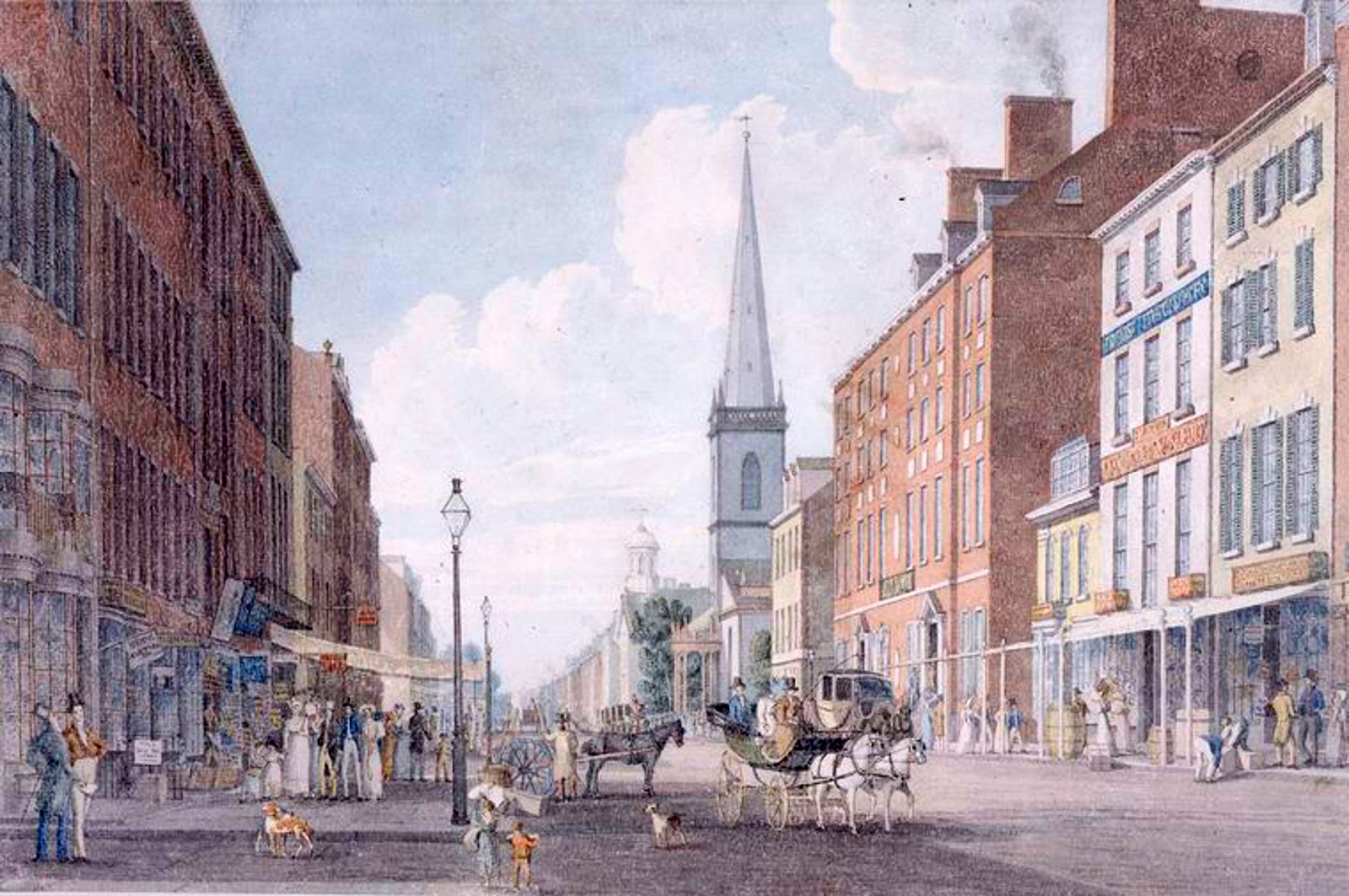
“Broadway and Trinity Church” (looking south from Liberty Street; Grace Church in the distance), 1830, watercolor by John William Hill (1812–1879). New York Public Library.
In 1831, Oliver Wendell Holmes published what would become one of his best-known poems, “The Last Leaf,” describing an old man he used to see around town:
They say that in his prime,
Ere the pruning-knife of Time
Cut him down,
Not a better man was found
By the Crier on his round
Through the town.
But now he walks the streets,
And looks at all he meets
Sad and wan,
And he shakes his feeble head,
That it seems as if he said,
“They are gone.”
The elderly man had become something of an eccentric figure, dressed in his “old three-cornered hat / And the breeches, and all that.” A half century later, in an afterword for a limited illustrated edition of the poem, Holmes revealed the identity of the townsman who inspired it:
The Poem was suggested by the sight of a figure well known to Bostonians of the [early 1830s], that of Major Thomas Melvill, “the last of the cocked hats,” as he was sometimes called. The Major had been a personable young man, very evidently, and retained evidence of it in “the monumental pomp of age”—which had something imposing and something odd about it for youthful eyes like mine. He was often pointed at as one of the “Indians” of the famous “Boston Tea-Party” of 1774. His aspect among the crowds of a later generation reminded me of a withered leaf which has held to its stem through the storms of autumn and winter, and finds itself still clinging to its bough while the new growths of spring are bursting their buds and spreading their foliage all around it.
Thomas Melvill was Herman Melville’s grandfather, and Oliver Wendell Holmes was Melville’s neighbor in Pittsfield, Massachusetts. Melville must have known of the poem, which was ubiquitous within a few years of its publication, and of its association with his grandfather. Although the story “Jimmy Rose” is set in New York rather than Boston, both “The New Leaf” and Melville’s own memories of his grandfather almost certainly served as inspirations. In the poem, Holmes writes that his “grandmamma” said Major Melvill’s “cheek was like a rose / In the snow”; in Melville’s story, “the most touching thing of all” about Jimmy Rose “were those roses in his cheeks”—a characteristic repeated several times. Jimmy becomes an old relic who has lost the fame of his youth, and he grows “somewhat musty, smacking of cocked hats and small clothes”; the italicized phrase, occasionally used by writers to describe veterans of the Revolutionary era, is one Melville would use again, at a later date, to describe his grandfather’s costume.

William Dillingham, in his study Melville’s Short Fiction 1853–1856, first detailed the similarities between the poem and the story and between Melville’s grandfather and Jimmy Rose. Yet, Dillingham points out, Jimmy is not only “a man whom time has passed by” but also a bankrupt, and Herman Melville “had known both types in his own family.” His father, Allan Melville, was a wealthy merchant whose career ended with insolvency. Likewise, his uncle Thomas Melvill, Jr., had been a success in France before a series of reversals forced him to return to Massachusetts and eke out a living on the family farm in Pittsfield, “reduced as a refugee, to humble employment in a region far from the gilded Versailles,” as Herman would later put it.

In the summer of 1850, Melville and his wife rented his late uncle’s lodgings from the new owners, who had renamed the place “Broadhall.” (The estate adjoined Arrowhead, the property purchased by Melville later that year with funds provided by his father-in-law.) The scholar Merton M. Sealts has pointed out that Melville’s descriptions of his uncle’s farmhouse are similar in wording to passages about the interior of Jimmy Rose’s home in downtown New York. “Though in [the story] the ‘great old house’ described in the opening paragraphs is given an urban rather than a rural setting,” notes Sealts, “its identity with Broadhall is unmistakable.” Other scholars have pointed out how the “lower wards” around Jimmy’s place “in C———— Street” resemble the neighborhood of Melville’s childhood home in New York, located at 55 Courtlandt Street (later Cortlandt Street, and currently the site of the World Trade Center).

In this story, then, Herman Melville was “probing his own life, . . . his familial past,” writes Dillingham. “The old house is a composite of Melville homes, and Jimmy Rose is a composite of Melville’s father, uncle, and grandfather.” But Jimmy is one of two characters featured in the story: his downfall and later life is witnessed and narrated by yet another old man, William Ford, who exhibits both an ambivalence toward Jimmy’s pathetic, bygone glory and an anxiety that he, too, will become “the last leaf.”

Notes: The first sentence of “Jimmy Rose” echoes the opening of the first chapter of Moby-Dick (1851): “Call me Ishmael. Some years ago—never mind how long precisely— . . .”

Nikolaus I, Prince Esterházy, was an eighteenth-century Hungarian prince remembered for his ornate style and clothing and for his patronage of the composer Joseph Haydn. Cosmo the Magnificent is Melville’s conflation of the fourteenth-century Italian banker Cosimo de’ Medici and his fifteenth-century grandson Lorenzo de’ Medici, also known as Lorenzo the Magnificent.

The compliment Jimmy “plagiarizes” when he flatters the general was allegedly made by Napoleon when he presented two jeweled pistols to Moreau: “The beauty of the pistols was greatly admired. ‘They appear very apropos.’ observed the First Consul, as he presented them to Moreau; and then turning to the Minister without alluding to their original object, he said, ‘but, Citizen Minister, here is a grand omission: Cause some of the victories gained by General Moreau to be engraven upon them. Do not order them all to be engraved, for it would be necessary to take off too many of the diamonds.’” (The Life of Napoleon Buonaparte, by Willem Lodewyk Van-Ess, 1810).

One of the narrator’s acquaintances suggest they go to “the Coffee-house” and arrange “a sleighing party to Cato’s.” The former establishment was probably Tontine Coffee House, the birthplace of the New York Stock Exchange, which from 1817 to 1834 had been converted into a tavern (and later a hotel). Cato’s Tavern, owned by Cato Alexander, was more than four miles to the north (now 54th Street and 2nd Avenue). Alexander, who had been freed from slavery, probably in 1799, opened his tavern in the early 1800s and served a largely white, often upscale clientele; in 1860, it was remembered as “the fashionable out of town resort for the young men of the day. . . . In sleighing times, it was almost impossible to obtain accommodation for the crowds that frequented the house.” Bad loans and investments forced Alexander to sell his building in the mid-1840s. In 1852 he opened an oyster saloon downtown, at 556 Broadway (in present-day SoHo); it closed within a year.

*   *   *
A time ago, no matter how long precisely, I, an old man, removed from the country to the city, having become unexpected heir to a great old house in a narrow street of one of the lower wards, once the haunt of style and fashion, full of gay parlors and bridal chambers; but now, for the most part, transformed into counting-rooms and warehouses. . . . If you don't see the full selection below, click here (PDF) or click here (Google Docs) to read it—free!

This selection may be photocopied and distributed for classroom or educational use.

Sunday, November 22, 2020

Poor Man’s Pudding and Rich Man’s Crumbs

Herman Melville (1819–1891)
From Herman Melville: Pierre, Israel Potter, The Piazza Tales, The Confidence-Man, Billy Budd, & Uncollected Prose

Feeding the Hungry after The Lord Mayor's Banquet, Interior of Guildhall, 1882, oil on canvas by French artist Marie Adrien-Emmanuel (1848–1891). Image from ArtNet. The tone of the annual event depicted in the painting had changed dramatically in the years since the free-for-all melee described in Melville’s tale, but Adrien nevertheless romanticizes the service, highlighting the virtues of charity over the hardships of poverty witnessed by other observers. The tradition of feeding the leftovers from the banquet to the poor continued into the early 1900s.
In the fall of 1849, Melville was in London looking for a publisher for his next novel, White-Jacket. On Friday, November 9, he witnessed the “bloated pomp” of the outdoor festivities for Lord Mayor’s Day and the following morning, while touring the city, Melville asked an “officer of the Fire Department” for directions to St. Swithin’s, a church designed by Christopher Wren. The officer escorted him to his destination and asked him if he’d also like to visit “the house where Whittington was born.” Richard Whittington—who was actually born in Gloucestershire in the 1350s—was lord mayor of London four times and the real-life inspiration for the popular folk tale, Dick Whittington and His Cat. Melville’s guide probably took him to a building known popularly as “Whittington’s house,” located on Swithin’s Passage.

To the south of this house was Guildhall, where the prestigious Lord Mayor’s Banquet had taken place the previous evening and where an event of a different nature was now on display. As Melville wrote in his journal:
. . . Thence, thro’ the influence of the Fire Officer, I pushed my way thro cellars & anti-lanes into the rear of Guildhall, with a crowd of beggars who were going to receive the broken meats & pies from yesterday’s grand banquet (Lord Mayor’s Day). — Within the hall, the scene was comical. Under the flaming banners & devices, were old broken tables set out with heaps of fowls hams &c &c pastry in profusion — cut in all directions — I could tell who had cut into this duck, or that goose. Some of the legs were gone — some of the wings, &c. (A good thing might be made of this)
Four years later, back in the United States, Melville was deeply in debt; his heavily mortgaged farm was threatened with foreclosure; his previous two novels, The Whale [Moby-Dick] and Pierre, had been commercial and critical debacles; no publisher was interested in his latest novel, The Isle of the Cross; and his family’s efforts to secure him a post in a foreign consulate had failed. Desperately needing cash, Melville wrote tales and essays for several publications. Between the summer of 1853 and the following spring, Melville wrote three diptychs for Harper’s New Monthly Magazine, each a pair of stories set first in America and then in England. One of them, “The Two Temples,” was rejected by the editors, because the target of Melville’s satire in the first “temple”—Grace Church in Manhattan—was the sexton of the church, who would have been identifiable to readers. The other two, “Poor Man’s Pudding and Rich Man’s Crumbs” and “The Paradise of Bachelors and the Tartarus of Maids,” were accepted and appeared anonymously (as did many of Melville’s short stories).

By mocking and contrasting American and British attitudes toward both poverty and charity, the twinned tales of “Poor Man’s Pudding” aim their satire more generally than did the unpublishable “Two Temples.” Melville dusted off the memory of the banquet of leftovers he had witnessed in Guildhall and made a “good thing” of it. He moved the setting back to the year 1814, borrowed from Charles Knight’s six-volume work London certain details of a banquet held that year, and put his reimagined historical event at the center of the second part of the diptych. Although there are no occasions or persons overtly serving as inspirations for the first episode of “Poor Man’s Pudding,” scholars have long contended that certain aspects were written in reaction to various writings by Melville’s contemporaries—particularly to a novel by his friend Catharine Maria Sedgwick and to the sermons of one of his Berkshire neighbors, the Unitarian minister Orville Dewey.

Sedgwick’s novels (with the notable exception of Hope Leslie) have been largely forgotten, even though she was one of the most prominent and popular of early American writers. Evoked by Melville in the very title of his story, her novel The Poor Rich Man, and the Rich Poor Man, garnered much acclaim upon its publication in 1836, with reviewers in many national publications praising the message it sent to the poor. The critic in The North American Review extolled Sedgwick for showing readers “how to be very rich with very little,—how to be entirely respectable and happy, and abundant in resources for serving others, with only such means as day-labor can supply, and of course such as every man in this country can command.” Few day-laborers would ever come across Sedgwick’s books; she was instead writing for those Americans who were in a position to offer charity. “The rich here can make no separating lines which the poor cannot pass,” she assured her readers. “It is the poor who fence themselves in with ignorance, and press themselves down with shiftlessness and vice.”

Orville Dewey offered his audiences a similar message. As Melville scholar Herschel Parker points out, Dewey’s memoir shows he “had long lamented that begging was permitted on the streets of New York, knowing full well that any misery felt by the poor was ‘not owing to the rich, but mainly to themselves.’” Dewey’s Discourses on Human Nature, Human Life, and the Nature of Religion is filled with passages about the “divine favours” and “natural gifts” available to everyone:
The beauty of the earth; the glories of the sky; the vision of the sun and the stars; the beneficent laws of universal being; the frame of society and of government; protecting justice and almighty providence . . . [Which] one of these would you part with for the wealth of the Indies, or all the splendours of rank or office?. . . Is he poor to whom the great storehouse of nature is opened? or does he think himself poor because it is God who has made him rich?
It is this type of high-flown “poetry” that Melville mocks, the didactic stories and admonishing sermons claiming that a simple shift in perspective is all one needs to see the poor or the working class as flourishing with America’s natural abundance. As the literary historian William B. Dillingham puts it, “the contrast Melville establishes is not so much between the poor and the rich as between poverty of the soul and glibness of the mouth. ‘Poor Man’s Pudding and Rich Man’s Crumbs,’ then, is very much a story about language.”

Notes: Philip Doddridge was an eighteenth-century British minister and hymnwriter. The lone book by Doddridge in the Coulters’ cabin is probably The Rise and Progress of Religion in the Soul (1745). Melville begins the second part of the tale with an anachronism; he establishes the year of the story as 1814 (which is also the year of the banquet described in Charles Knight’s London), but the Battle of Waterloo took place in 1815. The neighborhood of Five Points was a crime-ridden slum along the Bowery in lower Manhattan, recently depicted in the movie Gangs of New York (2002). Gog and Magog are two statues of Albion giants that have graced Guildhall, in various forms, for centuries.

*   *   *
“You see,” said poet Blandmour, enthusiastically—as some forty years ago we walked along the road in a soft, moist snow-fall, toward the end of March—“you see, my friend, that the blessed almoner, Nature, is in all things beneficent; and not only so, but considerate in her charities, as any discreet human philanthropist might be. . . .” If you don't see the full selection below, click here (PDF) or click here (Google Docs) to read it—free!

This selection may be photocopied and distributed for classroom or educational use.

Friday, March 6, 2015

The Lightning-Rod Man

Herman Melville (1819–1891)
From Herman Melville: Pierre, Israel Potter, The Piazza Tales, The Confidence-Man, Billy Budd, & Uncollected Prose

The Storm, oil on canvas, 1885, by American painter George Inness (1825–1894). Image courtesy of The Athenaeum.
For more than a century and a half, readers have puzzled over the inspiration for and meaning of Herman Melville’s comic tale “The Lightning-Rod Man,” which one contemporary compared to “Poe in his strangest mood.” In the 1940s Jay Leyda, who performed the scholarly groundwork for much of the information that has come down to us about Melville’s life, heard from Helen Gansevoort Morewood (the granddaughter of Melville’s brother) that the story was known in the family “as an encounter that Melville had had with a real lightning-rod salesman, who chose times of storm to pursue his trade.” This interesting biographical tidbit might be apocryphal, but Leyda adds that in 1853 “the Berkshires were enduring an intense lightning-rod sales campaign, with advertisements and warnings and editorials on the subject in all the Berkshire papers.” Other chroniclers have confirmed the ubiquitous presence of peddlers selling such products across the American countryside during this decade; you can see an 1859 advertisement for a copper lightning rod (like the one in Melville’s story) here.

Leyda also notes that, about the time Melville wrote this story, the Pittsfield Library Association acquired a copy of Cotton Mather's Magnalia Christi Americana, “a troubling and frightening record of religion in its most fiercely bullying and bigoted aspect.” Numerous scholars agree that Melville must have been familiar with Mather’s work, which contains a chapter titled "Ceraunius. Relating remarkables done by thunder" and includes the warning “make your peace with God immediately, lest by the stroke of his thunder he take you away in his wrath.” Thus, Melville could be portraying “a fear-instilling religionist playing the role of the peddler” (to quote the masterful biography by Hershel Parker) or, more generally, “sneering at proponents of the stern religious notion that God can strike sinners out of stormy clouds” (A Herman Melville Encyclopedia).

The literary critic William B. Dillingham argues persuasively, however, for a more complex reading of Melville’s “peculiar and elusive” tale. “The source of its strangeness is not so much the storm that rages in it or even the characterization of the salesman (though admittedly he is not your everyday Fuller Brush Man), but the narrator, who from the first paragraph is a highly unusual person.” The story’s peddler, far from being the voice of religious fear and dogma, “is the voice of science” and everything he says about “lightning rods and lightning is examined closely and measured against scientific fact” (at least as it was understood at the time). Dillingham cautions against equating the salesman merely with “Christian dogma, Satan, or Fear” and he concludes that Melville’s purpose “is not to present one character as good and the other as evil but to show through the ironic use of a Christian frame of reference how each views the other.” In other words, “Each of the two characters sees himself as righteous and the other as Satanic.”*

Although “The Lightning-Rod Man” is one of Melville’s lesser-known works, it was perhaps the most widely read of his stories during his lifetime and the only one that remained in print from its publication until his death. In 1858 it was included in William E. Burton’s Cyclopaedia of Wit and Humor, which was reprinted frequently until the end of the century. (Four years after Melville’s death the tale was also included alongside selections by Hawthorne, Irving, and Twain in Capital Stories by American Authors, published by The Christian Herald.) In the Burton anthology Melville’s story was accompanied by a drawing, making it—according to the Critical Companion to Herman Melville—“the only one of his signed works to appear with an original illustration during his lifetime.”

* Dillingham’s essay on “The Lightning-Rod Man” was published in Melville’s Short Fiction, 1853–1856 (1977), pages 168–82.

Notes: The Acroceraunian hills, more commonly known as the Ceraunian Mountains, are in southwestern Albania; as the Greek name (“thunder-split peaks”) implies, the region is famous for its lightning storms. Johann Tetzel (mentioned on page 762) became the Grand Commissioner for indulgences in Germany in 1517 and was accused for granting full forgiveness of sins in exchange for money, a practice assailed by Martin Luther.

*   *   *
What grand irregular thunder, thought I, standing on my hearthstone among the Acroceraunian hills, as the scattered bolts boomed overhead and crashed down among the valleys, every bolt followed by zigzag irradiations, and swift slants of sharp rain, which audibly rang, like a charge of spear-points, on my low shingled roof. . . . If you don't see the full selection below, click here (PDF) or click here (Google Docs) to read it—free!

This selection may be photocopied and distributed for classroom or educational use.

Friday, May 9, 2014

The Armies of the Wilderness

Herman Melville (1819–1891)
From The Civil War: The Final Year Told by Those Who Lived It

Skull and bones of unburied soldiers along Orange Plank Road in the Wilderness of Spotsylvania, photographed by G. O. Brown, 1864. Image courtesy of Civil War Saga.
Herman Melville and his brother Allan arrived in Virginia on April 16, 1864, to visit their cousin Lieutenant Colonel Henry Gansevoort— but the soldier was away from base when they arrived. By the time Gansevoort returned to camp, the Melville brothers had departed on a scouting mission in search of the Confederate rangers led by John S. Mosby, whose guerilla tactics plagued Union troops in a region around Middleburg known widely as “Mosby’s Confederacy.” A full five days after their arrival, then, the brothers finally met up with Gansevoort, and they were able to spend less than two days together.

During this period General Ulysses S. Grant was amassing his forces for a push against the Army of Northern Virginia, led by General Robert E. Lee. In early May Grant moved his army across the Rapidan River and the two sides clashed in the Wilderness of Spotsylvania, where the ground was already littered with the unburied skulls and bones from the previous year’s Battle of Chancellorsville. By mid-May the action moved from the Wilderness to the crossroads at Spotsylvania Court House.

For the forty-four year old novelist, the journey in April was something of a lark; “I enjoyed my visit very much, & would not have missed it on any count,” he wrote to his cousin on May 10, when Gansevoort would have been in the midst of one of the bloodiest battles of the Civil War. Melville closed this same letter with effusive well-wishes: “Farewell. May two small but choice constellations alight on your shoulders. May your sword be a terror to the despicable foe, & your name in after ages be used by Southern matrons to frighten their children by. . . . Farewell, my hero & God bless you.”

Yet, in spite of the holiday-like spirit of Melville’s jaunt (and the patriotic bravado of his letter), the horrors of the war were very much in evidence and presented him with the raw material for his first book of poetry, Battle-Pieces and Other Aspects of the War, published in 1866. The experiences of his visit to the front in April 1864 are immediately obvious in two of the book’s poems, “The Scout Toward Aldie,” about Mosby and the fear he instilled among Union forces, and “The Armies of the Wilderness.” A century later Robert Penn Warren would write:
It is, in many ways, a very remarkable document in the history of American poetry, and a remarkable commentary on the moment in American history. . . . In a very profound way it can be said that the Civil War made Melville a poet. . . . [It gave him] the kind of big, athletic, overmastering subject which he always needed for his best work, and it was bloodily certified by actuality.
Melville’s book, Warren notes, “reads like a log of the conflict, running in chronological order from the execution of John Brown to the Reconstruction.” In a more recent study, Cynthia Wachtell examines how these poems defied the conventions of the day by scorning comfortably bloodless images of the battlefield: “Melville boldly ventures to address topics that other Civil War writers of his day studiously avoided. . . . He refuses to disguise war’s horror.”

Notes: In Genesis 21, Paran (page 104) is the wilderness dwelling place of the outcast Ishmael. In 1719 Thomas, sixth Lord Fairfax of Cameron, inherited title to more than five million acres of land in Virginia—i.e., Lord Fairfax’s parchment deeds (p. 105). A stanza on page 107 refers to Confederate Lieutenant General Stonewall Jackson’s successful attack against Union forces during the Battle of Chancellorsville (May 3, 1863)—and his death when his own men accidentally opened fire on a returning scouting party.

*   *   *
If you don't see the full selection below, click here (PDF) or click here (Google Docs) to read it—free!

This selection may be photocopied and distributed for classroom or educational use.

Friday, March 21, 2014

The Capture of USS Essex

David G. Farragut (1801–1870)
From The War of 1812: Writings from America’s War of Independence

Two hundred years ago, on March 28, 1814, the American warship Essex engaged in a climactic life-or-death battle off the shore of Chile—and on board was David G. Farragut, then only twelve years old. Born in Tennessee as James Farragut, he was the son of Revolutionary War veteran and U.S. Navy officer George Farragut. When James was seven years old and living with his family in New Orleans, his mother cared for naval officer David Porter Sr. during his final illness. Shortly after Porter died, James’s mother succumbed to yellow fever and, in gratitude for the Farragut family’s treatment of his father, Captain David Porter Jr. offered to adopt the lad and sponsor his naval career. In December 1810, a mere nine years old, James was appointed as a midshipman in the U.S. Navy. (Midshipmen at the time were usually twelve to eighteen years old.) At some point he changed his first name to that of his adopted father.

During the War of 1812, unable to compete with the superior British Navy, the fledgling American fleet adopted the strategy of raiding and capturing British commercial vessels. Captain Porter was perfectly suited for this type of warfare, having fought against French and Tripoli pirates during the so-called Quasi-War at the end of the eighteenth century. Young Farragut was assigned to the USS
Essex, under Porter’s command, and in late 1812 the frigate rounded Cape Horn and became the first American warship to sail in the Pacific. During the following year, Porter and his crew seized a total of twelve British ships, and after one capture, twelve-year-old David was appointed commander of the prize and sailed it back to harbor at Valparaiso. Near this same harbor the Essex finally met its match when the ship lost its topmast and was cornered by two British warships.

Fifty-eight Americans were killed in the resulting slaughter, and dozens were wounded or missing. A well-known passage in Melville’s novel
White-Jacket questions the decision of Porter to not surrender once the battle was clearly lost:
[T]he American Captain continued to fight his crippled ship against a greatly superior force; and when, at last, it became physically impossible that he could ever be otherwise than vanquished in the end; and when, from peculiarly unfortunate circumstances, his men merely stood up to their nearly useless batteries to be dismembered and blown to pieces by the incessant fire of the enemy’s long guns. . . . I seek not to underrate any reputation which the American Captain may have gained by this battle. He was a brave man; that no sailor will deny. But the whole world is made up of brave men. . . . Nevertheless, it is not to be doubted, that if there were any common-sense sailors at the guns of the Essex, however valiant they may have been, those common-sense sailors must have greatly preferred to strike their flag, when they saw the day was fairly lost, than postpone that inevitable act till there were few American arms left to assist in hauling it down.
As for Farragut, he remained in the Navy until his death in 1870, four years after becoming the first admiral in American history. He is also famous for his victory at the Battle of Mobile Bay, when Union forces under his command captured the Confederacy’s last major port on the Gulf of Mexico. During the battle, he is said to have shouted various commands that have come down through history in shortened form as “Damn the torpedoes! Full speed ahead!”

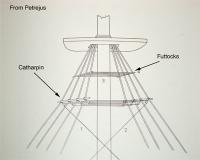
Notes: A paddy in the cat-harpins is a jack-of-all-trades. (Catharpins are ropes or iron cramps used to brace the shrouds on a ship. See an image here.) During his narrative, Farragut refers to the Essex Junior, which was a British whaler captured the previous year and rechristened by the Americans to assist in their attacks on British vessels.
*   *   *
During the action I was like “Paddy in the cat-harpins,” a man on occasions. I performed the duties of Captain’s aid, quarter-gunner, powder-boy, and in fact did everything that was required of me. . . . If you don't see the full selection below, click here (PDF) or click here (Google Docs) to read it—free!

This selection may be photocopied and distributed for classroom or educational use.

Friday, September 7, 2012

The Fiddler

Herman Melville (1819–1891)
From Herman Melville: Pierre, Israel Potter, The Piazza Tales, The Confidence-Man, Billy Budd, & Uncollected Prose

The Franconi Hippodrome in New York, 1853. Tinted lithograph with additional hand-coloring, created for cover of sheet music: Franconi Schottisch, composed by Frank Harris for the pianoforte. Courtesy of the New York Public Library Digital Collection/
In 1851–52 Herman Melville published Moby-Dick and Pierre, two novels which proved to be commercial and critical disappointments. While Moby-Dick never sold out its initial printing and would remain largely unheralded for seventy years, it was Pierre that brought out the knives; one advance notice wrote that the novel “appeared to be composed of the ravings and reveries of a madman.”

It’s not too difficult, then, to imagine Helmstone, the narrator of “The Fiddler,” as Melville’s alter ego. Written the year after the publication of Pierre and published anonymously in Harper’s in 1854, the story is a comic tale, one of several magazine pieces Melville wrote to help pay the bills. It opens with a poet mourning that his career has been doomed by a hostile notice from a critic. He encounters a friend who, oblivious to the author’s personal embarrassment, takes him to a circus to see a widely acclaimed clown. The contrast between scorned high-brow art and crowd-pleasing popular entertainment couldn’t be more dramatic, but what catches the poet’s eye is the reaction to the performance of Hautboy, a new acquaintance who resembles “an overgrown boy.”

Virtually all scholars and critics now agree that the story was written by Melville, but for many years it was considered apocryphal. Although the story was published anonymously, four consecutive editions of the index to Harper’s magazine listed the author as Fitz-James O’Brien. But there are two contemporary pieces that support Melville’s authorship: one is a scrapbook gathering his magazine pieces and the other is a handwritten list of his stories—both items were assembled by his wife. William B. Dillingham, in his study of Melville’s short fiction, adds a third element that supports Melville’s authorship. Thematically and structurally, “The Fiddler” resembles “The Happy Failure,” a Melville story published the same year; “critics have with good reason frequently linked them as companion pieces. . . . In ‘The Happy Failure’ Melville depicts an ass trying to be a lion; in ‘The Fiddler’ he shows a lion trying to be an ass.”

Notes: The Latin phrase magnum bonum (page 1197) means “a great good,” but it also refers to a type of succulent plum. William Henry West Betty (“Master Betty”), mentioned on page 1199, was one of the most famous child actors of the early nineteenth century. Born in 1791, he performed through the British Isles from 1803 to 1808; he would have still been alive when “The Fiddler” was published and died in 1874.

There are several literary and classical allusions scattered in the story. “The saying of the Athenian” (page 1196) can be found in Plutarch’s Life of Phocion. “Genius, like Cassius, is lank” (p. 1199) is a reference to Shakespeare's Julius Caesar: “Yond' Cassius has a lean and hungry look, He thinks too much; such men are dangerous.” Orpheus (p. 1201) is the mythical Greek poet whose music can charm the beasts. It was not Cicero (p. 1202) who was “traveling in the East” but rather a friend who wrote to Cicero to console him when his daughter died.

*   *   *
So my poem is damned, and immortal fame is not for me! I am nobody forever and ever. Intolerable fate! . . . If you don't see the full story below, click here (PDF) or click here (Google Docs) to read it—free!

This selection may be photocopied and distributed for classroom or educational use.