Showing posts with label Djuna Barnes. Show all posts

Sunday, June 5, 2022

Alla Nazimova

Djuna Barnes (1892–1982)
From The American Stage: Writing on Theater from Washington Irving to Tony Kushner

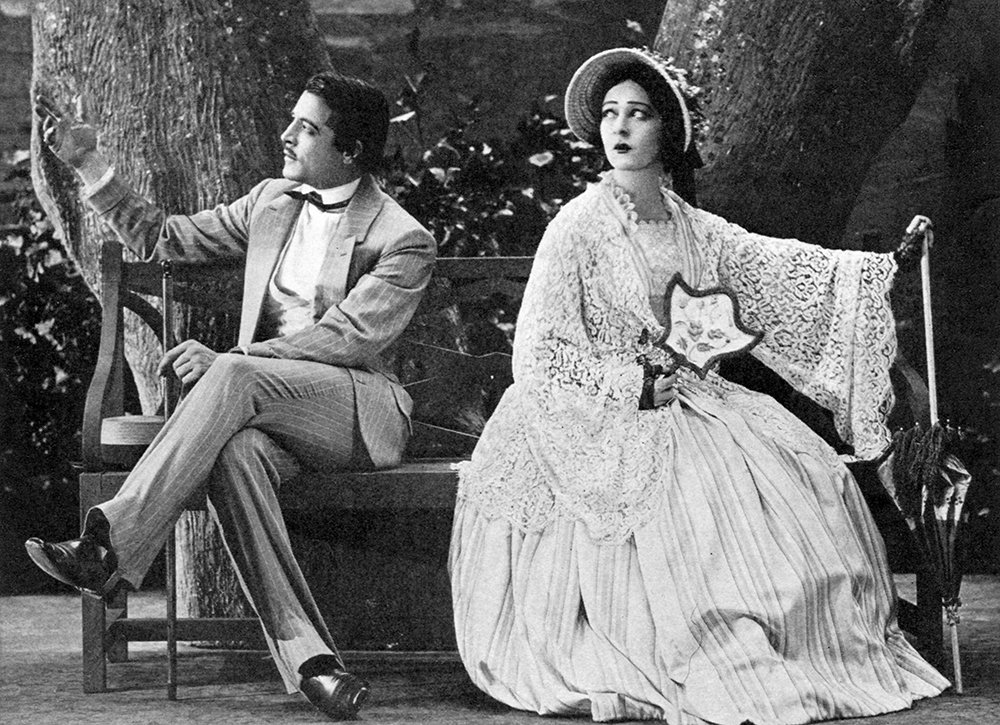
Elliot Cabot as Rakitin and Alla Nazimova as Natalia Petrovna in the 1930 Theatre Guild production of Turgenev’s A Month in the Country. Publicity photo by Vandamm Studio for the May 1930 issue of Theatre Magazine. (Wikimedia Commons)
“I don’t know if the Wall St. crash ruined everyone, but everyone thinks they are ruined, so the effect is all the same,” Djuna Barnes wrote to her friend Mina Loy in the summer of 1930. Two years earlier Barnes had published a surprise bestseller, Ryder, and she was now working on early drafts of her eventual masterpiece, Nightwood, while scrapping together a post-Crash income as a freelance journalist and as a columnist for Theatre Guild Magazine. She had recently separated from Thelma Wood, her lover for most of the 1920s, and she was gradually becoming a reclusive and ornery presence in Manhattan’s Greenwich Village, where she would later reduce Carson McCullers to tears and worry her neighbor, e. e. cummings, with her silence. In the letter to Loy, Barnes emphasized her increasing need for isolation: “I’ve gotten cranky & old-maid like—I don’t even like to have an animal looking at me, & when I lay a thing down I want to find it exactly where I put it—it’s as bad as that!”

Across the continent, in West Hollywood, the famous Russian-born American actress Alla Nazimova was one of the many people “ruined” (or nearly so) by the Wall Street crash; she lost much of the meager amount that remained of her savings. In reality, though, her decline was a decade in the making. During a successful stage career from 1906 to the mid-1910s, she wowed audiences and critics alike in various revivals of Henrik Ibsen’s plays. In 1916–7, she decamped for Hollywood, became the industry’s highest paid actress with a salary of $13,000 a week from Metro Pictures, and starred in more than a dozen blockbuster films that too often featured her in stereotypically vampish roles. During the 1920s, she lost most of her fortune—over half a million dollars—on two ventures. The first was her 1923 film adaptation of Oscar Wilde’s Salomé, with costumes and sets inspired by Aubrey Beardsley’s infamously risqué illustrations. The major studios wouldn’t touch it, so Nazimova sank more than $350,000 of her own money into the project. The result—now considered a pioneering art film classic—was minimally promoted by the independent distribution company that had agreed to shop it to theaters, and the movie’s commercial failure virtually ended her career in Hollywood.

The second venture was an $80,000 mansion she purchased in 1918 and, eight years later, converted into the Garden of Alla Hotel. Twenty-five guest bungalows were added to the main house and, to finance the expansion, the estate was mortgaged to the hilt, with Nazimova providing tens of thousands of dollars more in additional funding. The hotel quickly became the getaway of choice for celebrities and industry bigwigs; unfortunately, two years after its opening, both the business manager and the money vanished from the scene, leaving Nazimova heavily in debt. She sold the estate to pay off the loans and later learned that the husband-and-wife team who had convinced her to join them in the hotel deal had scammed previous victims in similar real estate rackets in the Midwest.

By the time of the Crash, Nazimova had been working the vaudeville circuit for several years. She briefly returned to the New York stage to costar with Eva Le Gallienne in the acclaimed 1928 Civic Repertory revival of Chekhov’s last play, The Cherry Orchard. In 1930 she went back again to Manhattan in the hope of resuscitating her Broadway career. She immediately landed the role of Natalia in the first American production of the Ivan Turgenev play, A Month in the Country. And that is when she met—and was interviewed by—Djuna Barnes.

Nazimova, Le Gallienne, and Barnes were linked to an informal network of lesbian and bisexual actresses and artists known as the “Sewing Circle”—an affectionate name Nazimova is credited with coining. Yet biographer Gavin Lambert is certain Nazimova was unaware that Barnes was the author of Ladies Almanack, a privately circulated roman à clef about lesbian expatriates in Paris—including “Doll Furious,” whose real name was Dolly Wilde (Oscar’s niece), a woman with whom Nazimova had an intense affair while in France at the end of her Hollywood career. For that matter, Nazimova was probably also unaware that she and Barnes had each had an affair with Maurice Sterne, the painter and sculptor. In any case, whatever the two women knew about each other’s overlapping personal relationships—they would never meet again—Barnes’s Theatre Guild Magazine profile about the highs and lows of Nazimova’s highbrow/lowbrow career is offbeat, respectful, and perhaps more than a little star-struck.

With rave reviews and a respectable box office, A Month in the Country proved to be the beginning of Alla Nazimova’s comeback. Twenty-two-year-old Katharine Hepburn, who had a bit part as a maid, remembered how she would stand in the wings “to watch her—she had great concentration—total—fascinating—couldn't take my eyes off her.” Nazimova next created the role of Christine Mannon in Eugene O’Neill’s play Mourning Becomes Electra. Thirty years earlier, in 1906, O’Neill had seen Nazimova in Hedda Gabler, her Broadway debut: “I went again and again for ten successive nights. The experience discovered an entire new world for me. It gave me my first conception of a modern theatre where truth might live.”

The pinnacle of her later career came in 1935, when she made her Broadway debut as a director, causing Brooks Atkinson of The New York Times to exclaim, “Probably Ibsen wrote Ghosts for Nazimova. . . . [She] has flooded the whole performance with the light of exalted acting.” Tennessee Williams, who saw the production on tour in St. Louis, recalled, “The first time I wanted to become a playwright was when I saw Alla Nazimova in Ghosts. She was so shatteringly powerful that I couldn't stay in my seat.” The future film critic Pauline Kael also saw the production and later remembered, “Nazimova gave the greatest performance I have ever seen on the stage, and my parents, who had seen her thirty years earlier, said that even then she was the finest actress they had ever seen.”

Notes: Nora Helmer, Hilda Wangel, and Rita Allmers are the lead characters in Ibsen’s A Doll's House, The Master Builder, and Little Eyolf, respectively. Natacha Rambova, the costume and set designer for Salomé, was the wife of Rudolph Valentino from 1923 to 1925. Nazimova costarred with Valentino in the 1921 adaptation of Dumas’s Camille, her last movie for Metro Pictures.

In 1923, George Bernard Shaw wrote to the Theatre Guild in New York, which was producing his latest play, Saint Joan, and recommended Nazimova for the lead role of Joan of Arc. The producers were dubious, given Nazimova’s recent forays in movies and music halls, but Guild directors Lawrence Langner and Theresa Helburn met with her to discuss the project, only to learn that she was unavailable because she had signed a contract for the vaudeville circuit. Barnes confuses the order of events and implies that Nazimova was nervous about signing a contract with Metro Pictures because of the missed opportunity to star in Shaw’s play, but Nazimova’s three-year arrangement with Metro had in fact concluded in 1921. Nazimova might have instead told Barnes that the incident made her nervous about signing a new movie contract, such as one that Paramount Pictures tentatively offered her in 1929.

*   *   *
When was it that I first saw Alla Nazimova? In what was she playing? . . . If you don't see the full selection below, click here (PDF) or click here (Google Docs) to read it—free!

This selection may be photocopied and distributed for classroom or educational use.

Sunday, January 26, 2020

The Days of Jig Cook

Djuna Barnes (1892–1982)
From The American Stage: Writing on Theater from Washington Irving to Tony Kushner

Playwrights George Cram “Jig” Cook and Susan Glaspell, photographed by Paul Thompson for “Talented Teams,” a pictorial on married couples with complementary or collaborative careers, in the New-York Tribune, July 15, 1917. Library of Congress.

Of her many writings, Glaspell is remembered most for her trio of works on the Hossack murder. The original articles on the crime appeared in 1900–01. She transformed the articles into Trifles in ten days after Jig Cook took her by surprise by announcing that her first play, which she had not yet conceived much less written, would be ready for the Provincetown Players’ 1916 summer season. It proved a hit not only for the Players (with her and her husband in the lead roles) but also for other theater groups. The following year she converted the play into her most famous story, “A Jury of Her Peers.” The original articles were a previous Story of the Week selection.
The following introduction by Laurence Senelick is reprinted from the Library of America anthology The American Stage:

The Provincetown Players began in an abandoned fish-house on a Cape Cod wharf in the summer of 1915 as an amateur workshop for experiments in playwriting and stage lighting. Its elected head, George Cram “Jig” Cook, said its goal was “to give Americans a chance to work out their ideas in freedom.” The group moved to a Greenwich Village stable and a membership subscription system, with new plays offered every three weeks. The fare was eclectic but fresh and ambitious: work by Eugene O’Neill, Susan Glaspell (Cook’s wife), the Yiddish playwright David Pinski, Strindberg, even Gilbert and Sullivan.

Growing dissension—some members wanted to continue experimenting, others to capitalize on success and go commercial—led to dissolution in 1924, but a second company took shape, formed by the disciples of New Stagecraft (O’Neill, Robert Edmond Jones, and Kenneth Macgowan), with an equally variegated repertory: Anna Cora Mowatt’s Fashion, Desire Under the Elms, plays by Stark Young and Paul Green. The revived Players dissolved two years later, a third avatar was killed off by the Wall Street crash. Macgowan later acknowledged that the company’s days “ended when Jig Cook went to Greece and Eugene O'Neill went to Broadway and the world.”

Among the 20-some hopefuls in at the birth of the Provincetown Players was the budding bohemian Djuna Barnes, the future author of the modernist classic Nightwood. She occasionally acted for them, in Tolstoy and Claudel, but chiefly contributed several one-act plays, some under the nom de plume Lydia Steptoe; “none of them,” judges the critic Ruby Cohn, “can be taken seriously.” Between 1929 and 1931, Barnes contributed a number of essays to Theatre Guild Magazine; her piece on the Players under Jig Cook is reprinted below. Subjective to the point of idiosyncrasy, playing variations on the standard forms of the memoir and the celebrity profile, they were “op-eds” avant la lettre.

Notes: Barnes name-drops a number of the actors and writers associated with the Provincetown Players; many will be familiar to readers. A handy list of the playwrights and their plays through 1922 can be found here. The actress and director Ida Rauh was known as the Duse of Macdougal Street for the “emotional exuberance of her acting” (to quote The New York Times); she left the stage after 1920 to focus on sculpture and painting. Other members of the company mentioned by Barnes include the singer Norma Millay (Edna St. Vincent Millay’s sister), scenic artist Charles Ellis, actress Mary Blair, who became briefly famous when she costarred with Paul Robeson in the Players production of O’Neill’s All God's Chillun Got Wings, and James Light, who directed many of O’Neill’s plays.

A founding member of Manhattan’s Theater Guild, the actress Helen Westley appeared in many of its productions, particularly in plays by George Bernard Shaw. She was also in the original Broadway production of O’Neill’s Strange Interludes. The American journalist and socialist John (Jack) Reed is most famous for his book Ten Days That Shook the World (1919). Hippolyte Havel (spelled as Hypolite by Barnes) was a Czech American anarchist who had been a political prisoner in Austria-Hungary.

The Brevoort was a hotel in Greenwich Village with a basement café that was a meeting place for many of the neighborhood bohemians. The Hell Hole was a common name for the Golden Swan, a popular hangout among O’Neill and his friends in Greenwich Village during the 1910s. Two decades after it closed in 1922, it served as the inspiration for the setting of The Iceman Cometh.
This selection may be photocopied and distributed for classroom or educational use.

*   *   *
For this week’s selection, we depart from the usual format and reproduce the selection, in its entirety, below.
You may also download it as a PDF or view it in Google Docs.


The Days of Jig Cook
Recollections of Ancient Theatre History But Ten Years Old

The world has grown a little older, the fat man even fatter, the local sponge has died, at a ripe old age at that, since the Provincetown Players used to write and act their own plays in their Greenwich Village stable; the girls who used to fight to get into the Provincetown casts have withered, and others sit and cannot recall just what it was that used to make them get into such heated controversies. Only a few talk of the days when Jig Cook used to drink to inspire others, of the past when Eugene O’Neill was a boy who was too shy to speak.

Helen Westley tells me that youth alone is idealistic. But Helen is right only in regard to American youth. Those who were young when I was also very young have not, with the passing of time, become seasoned to the bone. The things that produced the Provincetown Players and made the group what it was, has not made them what they are. Therefore we hear much talk of “lost atmosphere.” People speak of those early days as if they were a sort of collar stud which, by some diabolical mischance, had been mislaid by the injustice of God.

The French are otherwise. They too, to be sure, are idealistic in youth; but they are also idealistic in age. They do not speak of days “when.” In their lives there is no mislaid stud of enthusiasm. They have, with the peculiarly economical spirit of their race, kept their stud where they can, at any moment, lay their hands on it. It is perhaps not quite the bright stud it used to be, it is indeed not a little dulled, but it will be found in their dress shirt when they are laid out for their grave.

Just what was the spirit that took us to the Brevoort in nineteen hundred and fifteen, sixteen, seventeen, with the eagerness of the devotee? America is the one country where the minority should die young. Jack Reed was right, and some, not all of us, are wrong; and we shall be wrong until we have the ability to keep that collar stud from start to finish.

It is perhaps this inability that has made those early days something we recall with sentiment and exasperation. We perhaps sensed that we would not live long, which is the essence of precocity. No, we would not live long, so we would live hard and reach high. Ida Rauh would not always want to be the Duse of Macdougal Street; Jig Cook was already fatal with his untimely end. The rhythm of his emotional life was that of one walk precariously on the hyphen of Jig versus Parnassus. Jig said “What is this thing called life? Where did it come from? Where is it going? This past of life is just an accident . . . a moment.”—And then it was a long while.

Our destiny made us speak before we understood, write before we should and produce before we were able, the plays of John Reed, of Eugene O’Neill, of Susan Glaspell and Floyd Dell, of Maxwell Bodenheim, of George Cram Cook and Edna St. Vincent Millay; of Wilson and Kreymborg, of Wellman, of Steele and of Barnes. Before we were able we had mature grief and fleeting immortality.

In those days Greenwich Village was to the Bronxite just another name for hell and the devil. Now it is no longer the Village that will get a girl by her back hair and sling her into damnation, it is Paris. My own mother told me that I could never expect to live down that city. And when she thinks I am looking a little thin, or when she sees me watching a fly’s slow progress from wall to ceiling, or catches me being introspective—“It’s Paris! You needn’t tell me. Don’t I know what that place can do? I accepted your father under the Arc de Triomphe, and look at us now!”

Some said in those days that you could not get any nearer to original sin than by renting a studio anywhere below Fourteenth Street. It was as good as suicide to write a one-act play, have Norma Millay laugh at it, Charlie Ellis sit through it, or hear Mary Blair connecting it with the Torah or Swedenborg, which ability was one of her charms.

Poverty and paint, I was told, would bring about no good end. We sat and cherished this possibility with a politic humor. The Provincetown theatre was always just about to be given back to the horses. It had been a stable, and a stable, said my friends, it will be again. That this prophecy has never been fulfilled is due largely to M. Eleanor Fitzgerald, who by this organization has been turned into an eternal Eliza crossing the ice, and by main strength, and gift of a pioneer right arm, has so far kept the baby from drowning.

How can I recreate and analyse the spirit that was the early Provincetown and its people? Did I once know? Did any of us know? Do any of us know now since science has made the analysing process a sort of social ping pong? I doubt it. I have talked to Jimmy Light, and Jimmy does not seem to me to know.

If it was just youth, are there not young people today? The answer is, there are. But not by so much as a single feature do they resemble this other youth. They have enthusiasm, but they are not the enthusiasms that we had. There are still Little Art Theatres, and one-act plays, actors and actresses clamoring for parts, but they are not related to us by so much as a wish-bone.

Why, in those days we used to sit on the most uncomfortable benches imaginable in that theatre, glad to suffer partial paralysis of the upper leg and an entire stoppage of the spinal juices, just to hear Ida Rauh come out of the wings and say: “Life, bring me a fresh rose!”

Our private lives were going all wrong in all directions; we did not eat for days that we might save up to dine at the Brevoort; we sat in the Hell Hole and became both foreign and philosophic under the “Hélas bébé!” of Hypolite Havel; and “Life teems with quiet fun” from Christine, who ran the Provincetown restaurant and who could be counted on to lose all her hairpins, thus loosing her lovely golden hair, by no later than twelve of the clock. We used to sit in groups and recall our earlier and divergent histories. One would say, “I was well smacked by my mother for chewing the paint off the gate post”; another maintained that he had learned the value of madness when his father jumped from a window in an effort to prove gravity, and was picked up convinced. So we talked, and so we went our separate ways home, there to write, out of that confusion which is biography when it is wedded to fact, confession and fancy in any assembly of friend versus friend and still friends.

Of such things were our plays made. Eugene O’Neill wrote out of a dark suspicion that there was injustice in fatherly love. Floyd Dell wrote archly out of a conviction that he was Anatole France. I wrote out of a certitude that I was my father’s daughter, and Jig directed because he was the pessimistic Blue Bird of Greece.

Such things made atmosphere, as a chalk line on the floor of a magician’s home makes terror and expectation,—atmosphere and a dead line over which the general public could not go.

Then where was the catch in the blood? When and on what day, or succession of days did we, unknowingly, walk over our own dead line and into the general life of a world which, until then, had been the audience?

For though some of us have “come through,” we are less of that past than those who were never a part of it. This at least is true of me, and I think it is true of others.

Our legend was bought and paid for by those who did not live to walk over. That we are legend at all, that I have been asked to write of the days of Jig, that we are recalled by some with a sigh, by others with a shudder, is, I think, due to the lives we have lost and to the “ideals” that we cannot remember.

It was a kind of drunkenness that is beyond recall. Jig who could inspire divergent minds to work together for one idea, an ideal that was never quite clear to him, or if clear to him, one that he could not make clear to me nor to a number of others, sent his actors on the scent of no man’s rabbit. It was, I think, Jig’s rabbit, Jig’s conjuring trick; he knew the passes, he spoke the formula, he had the hat, but—was he too proud, or was he too wise, or was he too limited to produce the hare? Who knows?—but it made good hunting.

Originally published in the January 1929 issue of Theatre Guild Magazine.

Friday, June 8, 2012

“Come into the Roof Garden, Maud”

Djuna Barnes (1892–1982)
From Writing New York: A Literary Anthology

“After All, One Must Be Faithful to One’s Bracelets.”
Drawing by Djuna Barnes for her article “How the
Villagers Amuse Themselves,” New York Morning
Telegraph Sunday Magazine
, November 26, 1916.
Djuna Barnes was born 120 years ago this month (on June 12, 1912); by the time of her death six days after ninetieth birthday, she was regarded by the denizens of Manhattan’s Greenwich Village as a notoriously reclusive presence. Many New Yorkers who lived near the fabled Patchin Place from the 1940s to the 1970s have a Djuna story; many others failed in their fervent attempts to see her at all. Carson McCullers burst into tears when Barnes screamed at her to “go the hell away!” She terrified local business owners; once an unwary store clerk, asking for identification for her check payment, received the shouted response, “Identification? I was a friend of T. S. Eliot and James Joyce!” Weeks would go by, however, when hardly anyone would see her, and her neighbors reported hearing Estlin (e.e.) Cummings yell across the courtyard from the window of his own apartment, “Are ya still alive, Djuna?”

She wasn’t always the cantankerous New Yorker, but even as a young woman she had a reputation for boldness. Before she spent the 1920s in Paris, she lived for nearly a decade as an artist and writer in Brooklyn and Manhattan, first as a student for six months at the Pratt Institute, then as a journalist for various newspapers. According to one account, she landed her first job when she went to the offices of the Brooklyn Eagle and declared, “I can draw and write and you’d be foolish not to hire me.” Influenced by modernists such as James Joyce (whom she famously interviewed), her articles—about one hundred altogether—straddle the line between fiction and journalism, and she often illustrated her own work. Before the decade was out, Barnes joined up with the Provincetown Players, a group that included writers such as Theodore Dreiser, Edna Ferber, Edna St. Vincent Millay, Eugene O’Neill, and Wallace Stevens, and they produced three of her one-act plays.

In a recent review of Barnes’s writing from the period, Jenny Hendrix describes her “as one of the great carnival barkers of the nonfiction world—a kind of Tom Wolfe of her day. . . . Her writing—full of immigrants, circus animals, freaks, socialists, hipsters, servants, and suffragettes—revels in the atmosphere of the ‘yellow nineties,’ a period characterized by Wildean decadence.” A good number of her pieces are highly stylized profiles of the vibrant cityscape, and “Come into the Roof Garden, Maud” presents fictionalized, comic snapshots of the fashionable crowd chasing the latest craze of the 1910s: rooftop dancing.

Through August 12, 2012, visitors to New York can see a sampling of Djuna Barnes’s work from the 1910s on display at the Brooklyn Museum: “photographs, drawings, works on paper, and Barnes’s stories in newsprint, including eight illustrations she composed to accompany her newspaper columns.”

Notes: The title is a reference to “Come into the Garden, Maud," a popular nineteenth-century parlor song by Irish composer Michael Balfe, with lyrics based on Tennyson’s poem “Song from Maud." The Jardin de Danse (page 411), also called the New York Roof, was a popular open-air nightspot that opened in 1913 on the roof of the New York Theatre on 45th Street. The Four Hundred (page 412) is a term coined by social writer Ward McAllister to refer to the New York elite of the late nineteenth century, based on the number of people who could comfortably fit into Caroline Astor’s ballroom. A Rosetti [sic] neck (page 413) is the elongated female neck in paintings by Dante Gabriel Rossetti, especially in his portraits of Elizabeth Siddal. The Dolly sisters (page 415) were a popular dancing duo of the period; they often performed with Carlos Sebastian.

*   *   *
First of all, enter the atmosphere. . . . If you don't see the full story below, click here (PDF) or click here (Google Docs) to read it—free!

This selection may be photocopied and distributed for classroom or educational use.