Showing posts with label Carson McCullers. Show all posts

Saturday, December 16, 2017

Home for Christmas

Carson McCullers (1917–1967)
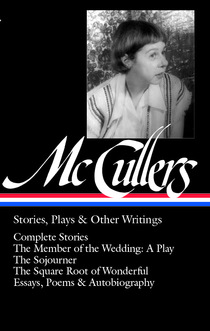
From Carson McCullers: Stories, Plays, & Other Writings

Wynnton School, Columbus, GA, late 1920s. Postcard (no. 28 in a series on Columbus landmarks) printed in 1930 by Curt Teich Co., Chicago, IL, from artwork provided by The White Company, Columbus, GA. As a third grader, Carson McCullers transferred to the Wynnton School in 1925, two years after the school’s current building was completed.
In the 1920s, when Carson McCullers was a child, a highlight of Christmas (perhaps the highlight) was gift giving—as is still true for most children. There was never any question about what to give little Lulu Carson, however. According to biographer Virginia Spencer Carr, even as a preschooler Carson would be asked what she wanted and the answer was, “I want book—lots of books, Mama.”

As an adult, Carr writes, “Carson was almost as excited over Christmas as she was over birthdays.” She would become obsessed with worrying (for weeks) and choosing and giving “just the right present,” but her inability to keep a secret led to occasionally awkward situations. When her therapist, Mary Mercer, learned that McCullers was planning to give her a mink stole, she was appalled—not by the idea of owning a stole but by the cost of one. Unaware that the fur had already been purchased (and was actually not that expensive, as far as such things go), Mercer decided to confront her patient directly and told her that she “simply did not want a blond mink stole and would not wear it.” McCullers was “crushed,” Carr reports, and the ensuing misunderstanding and kerfuffle (which eventually involved several others and is too complicated to be detailed here) ended up with a cousin being struck from the will.

Fortunately, most of McCullers’s holiday gestures did not end up with somebody being disowned. Friends and other writers gratefully recalled holidays spent with McCullers. In 1971 New York Times reporter Mary Cantwell asked Truman Capote to describe favorite Christmases of the past. In the mid-1940s, before he had become a published author, he met McCullers, who invited him to join her and her sister for Christmas at their place in Nyack, thirty miles up the Hudson in New York. On Christmas Eve his Manhattan apartment was robbed—along with all the presents he had bought for the hosts and their guests. “I went up anyway and we played old Marlene Dietrich records and drank wine. It was a very southern Christmas—my last southern Christmas up north—and we had all kinds of fried chicken and pies and cakes. And everybody was very kind about my not giving them a present although they all gave me one.”

It’s hardly a surprise, then, that among the writings published during McCullers’s all-too-short career are four autobiographical pieces about childhood Christmas memories. She wrote her first yuletide essay in 1949. The piece was commissioned by Mademoiselle for a special “Home for Christmas” issue, and it appeared alongside offerings with the same title by popular food writer M.F.K. Fisher and novelist Jessamyn West, author of The Friendly Persuasion. In what strikes us as a fitting close to McCullers’s centennial year, we present her version of “Home for Christmas” as our Story of the Week selection.

Note: One of the books Carson read during summer vacation was Hans Brinker; or, The Silver Skates: A Story of Life in Holland, an 1865 novel by American writer Mary Mapes Dodge.

*   *   *
Sometimes in August, weary of the vacant, broiling after noon, my younger brother and sister and I would gather in the dense shade under the oak tree in the back yard and talk of Christmas and sing carols. . . . If you don't see the full selection below, click here (PDF) or click here (Google Docs) to read it—free!

This selection is used by permission.
To photocopy and distribute this selection for classroom use, please contact the Copyright Clearance Center.

Friday, February 10, 2017

The Great Eaters of Georgia

Carson McCullers (1917–1967)
From Carson McCullers: Stories, Plays, & Other Writings

Barbecue stand near Fort Benning, Columbus, Georgia, 1940. Photograph by Marion Post Wolcott (1910–1990) for the Farm Security Administration (Library of Congress). “It is in Columbus that I feel most strongly the continuity of the past,” McCullers later wrote. “It was at Fort Benning that I spent the happiest years of my childhood.”
By 1953 Carson McCullers’s long-troubled marriage was at a breaking point: both she and her husband were in Paris, drinking heavily, and Carson found out that Reeves had (once again) forged her name on checks. That summer he attempted to kill himself and tried to talk Carson into committing suicide with him. She fled Paris and returned alone to her home in Nyack, New York.

A few months earlier, Holiday magazine had offered Carson McCullers fifteen hundred dollars to write a piece on Georgia and so she planned a return to the state in November to gather materials and memories. She wrote to a friend, the novelist and social critic Lillian Smith, and announced her intention to visit the town of Clayton and stay at the home Smith shared with Paula Snelling. But Smith was exhausted and frail; she had just finished her latest novel and had recently undergone surgery for breast cancer. “It was not easy to change Carson’s plans once her mind was made up,” Snelling later told McCullers biographer Virginia Spencer Carr. Yet when the unwanted guest arrived, they all stayed up late drinking bourbon and caught up on their lives and gossip, and McCullers complained at length about her rocky marriage.

During her stay with Smith and Snelling, McCullers learned that her husband had committed suicide in the Hôtel Chateau Frontenac on November 18. Although her hosts initially urged her to remain at their home to recover from the shock, McCullers insisted on going to visit Hervey Cleckley, a friend who was also a psychiatrist. Cleckley, who was busy at work (with coauthor Corbett H. Thigpen) on his book The Three Faces of Eve, later told Carr that he and McCullers discussed his research in psychopathology and talked at length about Reeves’s suicide. Their conversations helped McCullers understand both her husband and their relationship, as she later described in her unfinished memoir:
Hervey Cleckley has written a masterful book called The Mask of Sanity, and in that book I could see Reeves mirrored. Psychopathic people are very often charming. They live on their charm, their good looks and the weaknesses of wives or mothers.
McCullers finally returned to Nyack at the end of November—and the next day The New York Times published her husband’s obituary, which suggested as a possible cause of death injuries suffered from a car accident several weeks before. Yet the actual cause was hardly a secret to the couple’s acquaintances and, amidst the deluge of calls and condolences, there seemed to be a palpable sense of relief among some of McCullers’s friends. Carr reports that the actress Helen Hayes, who also lived in Nyack, dropped by and told Carson’s mother, “I’m not going to say I’m sorry, Bebe, because I don’t think I am.”

McCullers soon returned to the task of writing the article for Holiday, and she completed a version in early 1954. The events of the previous year surely explain the wistful and somewhat melancholy tone, and the essay was rejected because (according to biographer Josyane Savigneau) the magazine was “looking for a lighter, more descriptive, less personal piece.” McCullers’s various drafts were eventually stored at the Harry Ransom Center of the University of Texas, Austin, and in 2004 Carlos L. Dews and James G. Mayo collated the drafts to prepare “The Great Eaters of Georgia” for publication in Oxford American. It has been reprinted in the Library of America’s new collection Carson McCullers: Stories, Plays, & Other Writings and we present it here as our Story of the Week selection.

Notes: Une petite combine is French for “a little scheme.” Annie Dennis' Cookbook: A Compendium of Popular Household Recipes for the Busy Housewife was originally published in 1893; the volume familiar to McCullers was probably the later publication The New Annie Dennis Cook Book, which appeared in various editions between 1901 and 1921.

*   *   *
After many years in Europe I visited my home state, Georgia. Until that time I did not realize that I was homesick, homesick for Georgia countryside, Georgia voices, Georgia ways. . . . If you don't see the full selection below, click here (PDF) or click here (Google Docs) to read it—free!

This selection is used by permission.
To photocopy and distribute this selection for classroom use, please contact the Copyright Clearance Center.
Friday, November 11, 2016

Wunderkind

Carson McCullers (1917–1967)
From Carson McCullers: Stories, Plays, & Other Writings

Detail from Child at the Piano, 1928, by American artist Frederick Carl Frieseke (1874–1939). (Courtesy of The Athenaeum)
When Carson Smith McCullers was a little girl in Columbus, Georgia, her father bought a piano. As she recalled later in her unfinished autobiography, she had already learned how to play a bit at her aunt’s house, “so when my piano arrived I sat down immediately and began to play. To my parents this seemed like a miracle.” In 1929 she began studying with her first music teacher and practiced as many as five hours a day—to the chagrin of neighbors, “who did not appreciate being awakened as early as 4:00 a.m. by the music of Liszt, Chopin, and Beethoven being played by a ten-year-old,” writes biographer Virginia Spencer Car.

The next year Carson was accepted as the only student taught by Mary Tucker, a former soloist whose husband, an Army colonel, had recently moved to nearby Fort Benning. Strongly supported by her mother, Carson became convinced she was on her way to a brilliant career as a concert pianist. Yet, halfway through her four-year stint as Tucker’s student, she became severely ill with rheumatic fever, which was first misdiagnosed as pneumonia. Discouraged and fatigued, she began to doubt her abilities—both her talent and her endurance—and she told a friend her new hope was to become a writer. In 1934, when she graduated from high school, she finally confessed to her mother that she no longer felt she could become a concert pianist and, during the 1935–36 academic year, she went to New York University and enrolled in a creative writing class taught by Sylvia Chatfield Bates, a respected author of numerous now-forgotten novels and stories.

Of the pieces Carson wrote for the class, one in particular caught the eye of her teacher: “Wunderkind,” a story about a young girl who had been told at an early age that she was a prodigy. “Some will think this story is too long. I don’t,” Mrs. Bates wrote, but she suggested that her student make a few surgical cuts “to be on the safe side with regard to publication since you are unknown as yet.” She also advised Carson to prepare it for submission to Story magazine. And so, the year before the young author married and became Carson McCullers, her debut story was accepted for publication and appeared over the byline Carson Smith. “It is hard to realize the prestige and importance that Story magazine had at that time for young authors,” she later wrote. The nineteen-year-old received twenty-five dollars for her debut and celebrated by purchasing chocolate cake, a bottle of wine, and a story collection by Thomas Mann. Around this time, she also began working on a long story tentatively titled “The Mute,” which ultimately was published in 1940 as The Heart Is a Lonely Hunter.

Two decades later, in an essay written for Esquire, she reflected on how her first published story came about:
How does creation begin in any art? As Tennessee wrote The Glass Menagerie as a memory play, I wrote “Wunderkind” when I was seventeen years old, and it was a memory, although not the reality of the memory—it was a foreshortening of that memory. It was about a young music student. I didn’t write about my real music teacher—I wrote about the music we studied together because I thought it was truer. The imagination is truer than the reality.
*   *   *
Notes: Mister Bilderbach addresses Frances as Bienchen, a term of endearment meaning, literally, “little bee” (as in “my busy little bee”). Le Voyage de Monsieur Perrichon is an 1860 comedy by French playwrights Eugène Labiche and Édouard Martin. The Russian Tea Room (page 68), near Carnegie Hall, is a New York City restaurant established in 1927 by former members of the Russian Imperial Ballet.

McCullers refers to a number of musical pieces and performers, most of which do not require further identification for an understanding of the story. The following information is provided for the curious. The Second Hungarian Rhapsody (page 63) is Franz Liszt’s 1847 Hungarian Rhapsody No. 2 for Piano in C-Sharp Minor, the most popular and recognizable of Liszt’s nineteen Hungarian rhapsodies. The Bach Inventions are brief solo keyboard pieces by Johann Sebastian Bach that he wrote as exercises for his students. The Bloch (page 65) refers to a piano sonata by the Swiss-born American composer Ernest Bloch and performed for the first time the year before “Wunderkind” was published. The Fantasia and Fugue in G Minor was written for organ by Bach and later transcribed for piano by Liszt. The Harmonious Blacksmith (page 70) is the popular name for “Air and Variations,” the final movement of Handel’s Suite No. 5 in E Major. The four musicians mentioned on pages 67 and 68 were well known at the time of the story’s publication: English pianist Myra Hess, American violinist and conductor Yehudi Menuhin, Austrian pianist and composer Artur Schnabel, and Polish-born violinist Bronisław Huberman, founder in 1936 of the Palestine Symphony Orchestra, later known as the Israel Philharmonic Orchestra.

*   *   *
She came into the living room, her music satchel plopping against her winter-stockinged legs and her other arm weighted down with school books, and stood for a moment listening to the sounds from the studio. . . . If you don't see the full selection below, click here (PDF) or click here (Google Docs) to read it—free!

This selection is used by permission.
To photocopy and distribute this selection for classroom use, please contact the Copyright Clearance Center.